Showing posts with label Biology. Show all posts

Friday, March 18, 2016

Prehistoric puzzle no more: Illinois fossil a vertebrate


This undated reconstruction sketch provided by The Field Museum in Chicago shows what a Tully monster, an oddly configured sea creature. Fossil hunters have been finding samples of Illinois' state fossil in the Mazon Creek area for decades but no one has ever been able to say exactly what a Tully monster is. That changes Thursday, March 17, 2016, with the publication of a paper in the journal Nature. (Sean McMahon/The Field Museum via AP) MANDATORY CREDIT
.
View gallery

  • .
CHAMPAIGN, Ill. (AP) — For decades, fossil hunters combing the soil near a creek in north-central Illinois have been rewarded with the preserved remnants of a prehistoric creature, its wide-set eyes on stalks and a long, arm-like appendage extending from below them with a pincer-like mouth.
There was no doubt that the Tully monster, Illinois' official state fossil, was "very, very bizarre," said Scott Lidgard, a paleontologist at Chicago's Field Museum. But no one could say exactly what the soft-bodied creature was.
That changed Wednesday with a paper published in the journal Nature: A group of researchers, Lidgard included, concluded the Tully monster had a precursor to a backbone, making it a vertebrate, or primitive fish.
The origin of vertebrates is still an open question, he said, and there aren't many good examples of preserved, soft-bodied fishes. It's also personally important for Lidgard, who's long been charged with the museum's collection of 1,800 Tully monster fossils, the largest in the world.
"I'm pretty excited because I've had to live with this guy, something I wish I knew what it was, for my 32 years here," he said. "And it's been a puzzle."
The fossilized remnants of the Tully monster have not been found outside Illinois, only in the Mazon Creek area, about 50 miles southwest of downtown Chicago. About 300 million years ago, the spot was a warm coastal marsh along a long-gone sea near the equator. This was before the dinosaurs; Tyrannosaurus rex didn't come about until roughly 67 million years ago.
The abundant plant life eventually became coal, and eons later, strip mining dug up piles of earth and shale — and fossilized prehistoric life. Paleontologists consider the area a treasure because of plant and animal life that was, for reasons not fully known, set in stone quickly enough before decay could set in.
An amateur paleontologist named Francis Tully unearthed the first Tully monster in 1958. Thousands of other examples have since been found by fossil hunters combing the area, much of it now set aside as Mazonia-Braidwood State Fish and Wildlife Area.
Mining faded in the 1970s, and, after decades of fossil hunting, the area does not yield quite as many specimens as it used to, said Colleen Schmidt, an office associate at the state fish and wildlife area.
But those who know where to look — "they do have their (secret) spots," Schmidt said — can still find plenty. They leave with oblong nodules of rock, some of which, when broken open, contain fossils; often it's plant life, like prehistoric ferns that are hard to imagine on Illinois' prairie.
The Tully monster fossils show a creature that swam the shallows of that ancient sea and ranged from a few inches long to roughly a foot. There are traces of other, more-familiar animals, Lidgard said, especially the odd mouth and its teeth, known as stylets, that share some characteristics with squids and lampreys. The eye stalks are similar to some snails.
But the team of researchers from the museum, Argonne National Laboratory, Yale University and elsewhere focused on some of the fossils' curious raised areas. Those areas were once believed to be remnants of the animal's guts, but that kind of soft tissue would have been pressed flat as it was fossilized, so these areas must have been something harder, more resilient, they thought.
"It has a cartilage skeletal system," Lidgard said the group concluded. "It runs along the midline. Beneath it is the nerve cord ... Sort of a precursor to a spine."
Even with the discovery, the Tully monster remains in many ways an enigma.
That strange mouth, extended away from its body, may have helped it as a predator, Lidgard said, or maybe it scavenged for food. The wide-set eyes may have given it a greater field of vision for hunting, but no one knows for sure.
And Mazon Creek continues to offer more mysteries.
"There's an animal called the H animal," named for its odd, H-shaped body, Lingard said. "We don't know what it is."
___
Online:
Nature: www.nature.com/index.html
Field Museum, www.fieldmuseum.org/
Mazonia-Braidwood State Fish and Wildlife Area: www.dnr.illinois.gov/Parks/Pages/Mazonia-Braidwood.aspx

Sunday, September 21, 2014

Discovery Science: Alien Planet Earths (2014)


Friday, February 21, 2014

Roswell full Interview *TOP SECRET* 1947 (8:00:00)


Source


Friday, December 14, 2012

Everybody DOES have a twin: Photographer creates amazing portraits of STRANGERS who look the double of each other

At first glance, it's an elegant set of portraits of twins - but look more closely and the secret is revealed.
None of the individuals captured by photographer Francois Brunelle are related by blood, their faces just have strikingly similar characteristics. 
Mr Brunelle, who lives in Québec, has studied the human face since he started out as a photographer at the age of 18 in 1968.
The same...but different: Nathaniel (who did not give his last name) and Edward Toledo, pictured in Montreal in 2003, are remarkably similar but not twins

Thursday, January 19, 2012

Antarctic lake drilling mission edges closer


Lake Ellsworth  BAS
The advance party has arrived to set up vital equipment and supplies

 An ambitious plan to explore a vast lake trapped beneath the Antarctic ice is a step closer to becoming reality.
An advance party has braved freezing temperatures to set up vital equipment and supplies at Lake Ellsworth.
The project by UK engineers to drill through the two-mile-thick ice-sheet is scheduled for the end of the year.

Wednesday, January 04, 2012

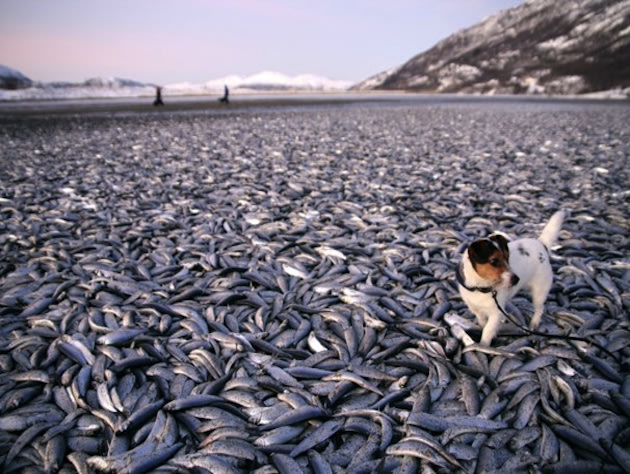
20 tons of herring wash up on Norway coast


Molly the dog discovers 20 tons of herring on a Norwegian beach

The fish remains turned up on Norway's northern coast on New Year's Eve, and officials are still looking to explain just how and why they showed up.

World-first hybrid shark found off Australia


Scientists said on Tuesday that they had discovered the world's first hybrid sharks in Australian waters, a potential sign the predators were adapting to cope with climate change.
The mating of the local Australian black-tip shark with its global counterpart, the common black-tip, was an unprecedented discovery with implications for the entire shark world, said lead researcher Jess Morgan.

Sunday, December 25, 2011

Watch The Secret Life of Chaos, with Prof. Jim Al-Khalili


Chaos theory has a bad name, conjuring up images of unpredictable weather, economic crashes and science gone wrong. But there is a fascinating and hidden side to Chaos one that scientists are only now beginning to understand. It turns out that chaos theory answers a question that mankind has asked for millennia – how did we get here?

Friday, December 16, 2011

Could hackers develop a 'computer virus' to infect the human mind?


  • Synthetic biology is 'out-accelerating evolution' - expert
  • Bio-crime today is 'like computer crime in the Eighties'
  • Viruses could be used to influence behaviour - and we may have to 'learn how to counterattack'
  • 'One of the most powerful technologies in the world'
Californian biologist Andrew Hessel says, 'Cells are living computers and DNA is a programming language,' but warns that this could lead to viruses and bacteria used to 'hack' human minds
The field of 'synthetic biology' is in its infancy. We can 'tweak' the genetics of life forms - but billionaire entrepreneur Craig Venter only created 'artificial life' for the first time last year, christening his life form 'Synthia'.
But experts working within the field believe that our expertise is out-accelerating natural evolution by a factor of millions of years - and some warn that synthetic biology could spin out of control.
It could lead, says Andrew Hessel of Singularity University, on Nasa's research campus, to a world where hackers could engineer viruses or bacteria to control human minds.
Hessel believes that genetic engineering is the next frontier of computing. 
'This is one of the most powerful technologies in the world,' says Hessel 'Synthetic biology - the writing of life.'
'I advocate that cells are living computers and DNA is a programming language.'
'I want to see life programmed and used to solve global challenges so that humanity can achieve a sustainable relationship within the biosphere,' he says.It's growing fast. It will grow faster than computer technologies.'
He predicts a world where we can 'print' DNA, and even 'decode' it. But he warned, in a speech at technology conference TXM, that viruses and bacteria send chemicals into human brains - and could be used to influence, or even 'control' their host.

Friday, October 28, 2011

7 billion people and you: What's your number?


The world's population is expected to hit seven billion in the next few weeks. After growing very slowly for most of human history, the number of people on Earth has more than doubled in the last 50 years. Where do you fit into this story of human life? Fill in your date of birth below to find out.
Source

Friday, October 14, 2011

Bizarre case of the woman who says
she went from age 23 to 73 in 'a few days'


These pictures may look like an attractive woman in her 20s and her grandmother.
But they are said to be the same person – apparently taken just days apart.
The young Vietnamese woman at the centre of the improbable medical case, Nguyen Thi Phuong, claims the transformation may have come about because of an extreme allergy to seafood.
Nguyen, 26, says she developed this puffy face and sagging skin in 2008 but was too poor to seek treatment. Earlier this month, doctors said they would examine her free of charge.
Nguyen’s husband, carpenter Thanh Tuyen, insists the story is true and his love has not faded for his once-beautiful wife.
Nguyen Thi Phuong age 21
Nguyen Thi Phuong at 26

Rapid ageing: A mystery condition has apparently   caused Nguyen Thi Phuong's face to sag and wrinkle over a matter of day.

Monday, September 19, 2011

German forest boy is telling the truth, say police


The story of an English–speaking boy who emerged after five years living in a German forest is "credible" and his accent may prove the key to establishing his true identity, German police said.

German police: story of 'British' boy who emerged from woods 'credible'
The boy, 17, told police that his father had died and
he had buried him in a shallow grave in the woods

“His story is highly unusual and raises some questions,” a police spokesman told The Daily Telegraph. “But we believe it is credible – that is why we are investigating.”
The teenager, who gave his name only as Ray, turned up at Berlin’s City Hall on Sept 5 claiming to have been living in the forest with his father for five years.

Friday, August 19, 2011

Aliens may destroy humanity to protect
other civilisations, say scientists


Rising greenhouse emissions could tip off aliens that we are a rapidly expanding threat, warns a report
A scene from Mars Attacks!
When they see what a mess we've made of our planet, extraterrestrials
may be forced to take drastic action. Photograph: PR
 
It may not rank as the most compelling reason to curb greenhouse gases, but reducing our emissions might just save humanity from a pre-emptive alien attack, scientists claim.
Watching from afar, extraterrestrial beings might view changes in Earth's atmosphere as symptomatic of a civilisation growing out of control – and take drastic action to keep us from becoming a more serious threat, the researchers explain.

Saturday, May 14, 2011

Zenattitude - Nautilus


Original Release Date: 9 April 2002
Label: Essential Media Group

Nautilus (from Greek ναυτίλος, 'sailor') is the common name of marine creatures of cephalopod family Nautilidae, the sole extant family of the superfamily Nautilaceae and of its smaller but near equal suborder, Nautilina. It comprises six living species in two genera, the type of which is the genus Nautilus. Though it more specifically refers to species Nautilus pompilius, the name chambered nautilus is also used for any species of the Nautilidae.

Nautilidae, both extant and extinct, are characterized by involute or slightly evolute shells that are generally smooth, with compressed or depressed whorl sections, straight to sinuous sutures, and a tubular, generally central siphuncle.[2] Having survived relatively unchanged for millions of years, nautiluses represent the only living members of the subclass Nautiloidea, and are often considered "living fossils."

The name "Nautilus" originally referred to the Argonauta, otherwise known as paper nautiluses, because the ancients believed these animals used their two expanded arms as sails (cf. Aristotle Historia Animalium 622b). However, this octopus is not closely related to the Nautiloidea.Source

Related Posts with Thumbnails

Wednesday, March 23, 2011

Here are some I made earlier (Image: Susumu Nishinaga)
FOR the first time viable mouse sperm have been grown outside the testes. If the technique can be repeated with human sperm, it could lead to new ways of treating infertile men.
Takuya Sato at Yokohama City University in Japan and colleagues extracted germ cells from the testes of newborn mice that had not yet begun producing sperm. They placed the cells in agarose gel soaked in nourishing chemicals and hormones such as fetal bovine serum and testosterone. The team had first engineered the mice so that a protein only present in fully grown sperm would fluoresce green. Sure enough, around one month later, the team spotted the glowing protein in nearly half of their samples.
Sato's team then fused the sperm with eggs from female mice and created healthy embryos. When these embryos were implanted into females they produced healthy offspring which were able to mate and give birth to their own pups.
The team also confirmed that the testes tissue could be frozen and thawed without damage (Nature, DOI: 10.1038/nature09850).
"People have been trying to do this for years, but it takes an awful lot of trial and error," says Erwin Goldberg, a cell biologist at Northwestern University in Chicago, who was not involved in the study. The key to the team's success, Goldberg says, was patience: they kept mixing chemicals in the lab until they found exactly the right recipe to keep testes cells alive in a petri dish and satisfy all their nutritional requirements.
Earlier studies using different methods achieved similar, but less promising results. In 2006, Karim Nayernia at the University of Newcastle, UK, transformed stem cells from mouse embryos into sperm cells but most of the offspring died prematurely.
If researchers could convert germ cells from an infertile man into sperm cells, they might be able to pinpoint exactly where something goes wrong in the sperm's development and fix it, says Martin Dym, a reproductive biologist at Georgetown University in Washington DC.
The technique could also help prepubescent boys with cancer, who are not yet producing mature sperm, by growing sperm cells that can be frozen before radiation therapy.


Source

Related Posts with Thumbnails

Monday, March 07, 2011

NASA scientist finds evidence of alien life


Bacteria in Meteorites Aliens Journal of Cosmology
Aliens exist, and we have proof.
 
That astonishingly awesome claim comes from Dr. Richard B. Hoover, an astrobiologist at NASA’s Marshall Space Flight Center, who says he has found conclusive evidence of alien life — fossils of bacteria found in an extremely rare class of meteorite called CI1 carbonaceous chondrites. (There are only nine such meteorites on planet Earth.) Hoover’s findings were published late Friday night in the Journal of Cosmology, a peer-reviewed scientific journal.
“I interpret it as indicating that life is more broadly distributed than restricted strictly to the planet earth,” Hoover, who has spent more than 10 years studying meteorites around the world, told FoxNews.com in an interview. “This field of study has just barely been touched — because quite frankly, a great many scientist would say that this is impossible.”
Hoover discovered the fossils by breaking apart the CI1 meteorite, and analyzing the exposed rock with a scanning-electron microscope and a field emission electron-scanning microscope, which allowed him to detect any fossil remains. What he found were fossils of micro-organisms (pictured below), many of which he says are strikingly similar to those found on our own planet (pictured above).
alien-life-figure-4a“The exciting thing is that they are in many cases recognizable and can be associated very closely with the generic species here on earth,” said Hoover. Some of the fossils, however, are quite odd. “There are some that are just very strange and don’t look like anything that I’ve been able to identify, and I’ve shown them to many other experts that have also come up stump.”
In order to satisfy the inevitable hoard of buzz-killing skeptics, Hoover’s study and evidence were made available to his peers in the scientific community in advance of the study’s publications, giving them a chance to thoroughly dissect his findings. Comments from those who decided to sift through the evidence will be published online, alongside the study.
“Given the controversial nature of his discovery, we have invited 100 experts and have issued a general invitation to over 5,000 scientists from the scientific community to review the paper and to offer their critical analysis,” writes Harvard-Smithsonian Center for Astrophysics scientist Dr. Rudy Schild, who serves as the Journal of Cosmology’s editor-in-chief. “No other paper in the history of science has undergone such a thorough vetting, and never before in the history of science has the scientific community been given the opportunity to critically analyze an important research paper before it is published.”
Needless to say, if Hoover’s conclusions are found to be accurate, the implications for human life will be staggering. Here’s hoping that he’s right.
Update: While the Journal of Cosmology says that “no other paper in the history of science has undergone such a thorough vetting,” some highly respected names in the scientific community are challenging the validity of Cosmology, and the findings of Dr. Hoover.
“[The Journal of Cosmology] isn’t a real science journal at all,” says PZ Meyers in Science Blogs, “but is the ginned-up website of a small group of crank academics obsessed with the idea of Hoyle and Wickramasinghe that life originated in outer space and simply rained down on Earth.”
So there you have it — this is either reality-altering news, or the work of kooks. Our hearts believe, but our brains are kind of bummed.
Source

Related Posts with Thumbnails

Monday, November 29, 2010

Telomerase reverses ageing process

Dramatic rejuvenation of prematurely aged mice hints at potential therapy.

Ewen Callaway
telomeres 
Protecting chromosome tips doesn't just prevent ageing. It can reverse it. 
Peter Lansdorp/Visuals Unlimited/Corbis
Premature ageing can be reversed by reactivating an enzyme that protects the tips of chromosomes, a study in mice suggests.
Mice engineered to lack the enzyme, called telomerase, become prematurely decrepit. But they bounced back to health when the enzyme was replaced. The finding, published online today in Nature1, hints that some disorders characterized by early ageing could be treated by boosting telomerase activity.
It also offers the possibility that normal human ageing could be slowed by reawakening the enzyme in cells where it has stopped working, says Ronald DePinho, a cancer geneticist at the Dana-Farber Cancer Institute and Harvard Medical School in Boston, Massachusetts, who led the new study. "This has implications for thinking about telomerase as a serious anti-ageing intervention."
Other scientists, however, point out that mice lacking telomerase are a poor stand-in for the normal ageing process. Moreover, ramping up telomerase in humans could potentially encourage the growth of tumours.

Eternal youth

After its discovery in the 1980s, telomerase gained a reputation as a fountain of youth. Chromosomes have caps of repetitive DNA called telomeres at their ends. Every time cells divide, their telomeres shorten, which eventually prompts them to stop dividing and die. Telomerase prevents this decline in some kinds of cells, including stem cells, by lengthening telomeres, and the hope was that activating the enzyme could slow cellular ageing.
Two decades on, researchers are realizing that telomerase's role in ageing is far more nuanced than first thought. Some studies have uncovered an association between short telomeres and early death, whereas others have failed to back up this link. People with rare diseases characterized by shortened telomeres or telomerase mutations seem to age prematurely, although some tissues are more affected than others.
“They are not studying normal ageing, but ageing in mice made grossly abnormal.”
David Harrison
Jackson Laboratory, Bar Harbor, Maine

 
When mice are engineered to lack telomerase completely, their telomeres progressively shorten over several generations. These animals age much faster than normal mice — they are barely fertile and suffer from age-related conditions such as osteoporosis, diabetes and neurodegeneration. They also die young. "If you look at all those data together, you walk away with the idea that the loss of telomerase could be a very important instigator of the ageing process," says DePinho.
To find out if these dramatic effects are reversible, DePinho's team engineered mice such that the inactivated telomerase could be switched back on by feeding the mice a chemical called 4-OHT. The researchers allowed the mice to grow to adulthood without the enzyme, then reactivated it for a month. They assessed the health of the mice another month later.
"What really caught us by surprise was the dramatic reversal of the effects we saw in these animals," says DePinho. He describes the outcome as "a near 'Ponce de Leon' effect" — a reference to the Spanish explorer Juan Ponce de Leon, who went in search of the mythical Fountain of Youth. Shrivelled testes grew back to normal and the animals regained their fertility. Other organs, such as the spleen, liver and intestines, recuperated from their degenerated state.
The one-month pulse of telomerase also reversed effects of ageing in the brain. Mice with restored telomerase activity had noticeably larger brains than animals still lacking the enzyme, and neural progenitor cells, which produce new neurons and supporting brain cells, started working again.
"It gives us a sense that there's a point of return for age-associated disorders," says DePinho. Drugs that ramp up telomerase activity are worth pursuing as a potential treatment for rare disorders characterized by premature ageing, he says, and perhaps even for more common age-related conditions.

Cancer link

The downside is that telomerase is often mutated in human cancers, and seems to help existing tumours grow faster. But DePinho argues that telomerase should prevent healthy cells from becoming cancerous in the first place by preventing DNA damage.
David Sinclair, a molecular biologist at Harvard Medical School in Boston, agrees there is evidence that activating telomerase might prevent tumours. If the treatment can be made safe, he adds, "it could lead to breakthroughs in restoring organ function in the elderly and treating a variety of diseases of aging."

 Other researchers are less confident that telomerase can be safely harnessed. "Telomere rejuvenation is potentially very dangerous unless you make sure that it does not stimulate cancer," says David Harrison, who researches ageing at the Jackson Laboratory in Bar Harbor, Maine.

Harrison also questions whether mice lacking telomerase are a good model for human ageing. "They are not studying normal ageing, but ageing in mice made grossly abnormal," he says. Tom Kirkwood, who directs the Institute for Ageing and Health at Newcastle University, UK, agrees, pointing out that telomere erosion "is surely not the only, or even dominant, cause" of ageing in humans.
DePinho says he recognizes that there is more to ageing than shortened telomeres, particularly late in life, but argues that telomerase therapy could one day be combined with other therapies that target the biochemical pathways of ageing. "This may be one of several things you need to do in order to extend lifespan and extend healthy living," he says. 

References
Related Posts with Thumbnails
Bookmark and Share

Sunday, November 07, 2010

Eating persimmon leaves inhibits weight gain and lowers lipid levels


Supplementing a high-fat diet with powdered leaves taken from Native American persimmon trees can inhibit weight gain and lower both food intake and plasma lipid levels, research shows.
Scientists believe that the rich fiber and phenolic content of persimmon leaves, which are commonly used to make tea in India, increases the amount of lipids removed from the body as feces.
"Since the persimmon leaves have beneficial effects on hemostatsis, constipation, hypertension, apoplexy, and atherosclerosis, they have been broadly applied in food and medicine," says J Lee, from the Ottogi Research Center in Kyonngi-do, The Republic of Korea and colleagues.
To investigate if the leaves also improved metabolism and lipid levels, the team fed three groups of rats either a normal control, high-fat, or high-fat with powdered whole persimmon leaf diet, for 6 weeks.
Eating the high-fat diet without persimmon leaves increased the rats' body weight by an average 114% in comparison with those fed the normal control diet.
However, rats eating the persimmon leaf supplemented high-fat diet had a final body weight similar to that of the normal control group after 6 weeks.
"Thus indicating that persimmon leaf supplementation suppressed the excess body weight gain that could be induced by high-fat feeding," say the authors in the journal Food and Chemical Toxicology.
They added that these rats gained less weight because persimmon leaf consumption suppressed their food intake, perhaps via the hormone leptin, levels of which were higher in the leaf-supplemented group than the high-fat only group.
Eating persimmon leaves with a high-fat diet also created a less atherogenic lipid profile by lowering plasma total cholesterol and triglyceride concentrations, while increasing the ratio of high-density lipoprotein cholesterol to total cholesterol.
Finally, the researchers say the fact that rats eating persimmon leaves had a higher daily fecal weight than the high-fat only group, shows that the "combined effect of high-fiber and high-phenolic content in persimmon leaf itself could enhance the fecal excretion of neutral and acidic sterol."
They conclude: "Efficacy tests of lipid-lowering action of persimmon leaf suggest that this whole persimmon leaf food would be beneficial for regulation of lipid metabolism or prevention of hyperlipidemia in an experimental animal model."

Source
Related Posts with Thumbnails
Bookmark and Share

Saturday, November 06, 2010

The Secret Life of Chaos, with Prof. Jim Al-Khalili

THE SECRET LiFE OF CHAOS (2010) Chaos theory has a bad name, conjuring up images of unpredictable weather, economic crashes and science gone wrong. But there is a fascinating and hidden side to Chaos, one that scientists are only now beginning to understand. It turns out that chaos theory answers a question that mankind has asked for millennia how did we get here? In this documentary, Professor Jim Al-Khalili sets out to uncover one of the great mysteries of science how does a universe that starts off as dust end up with intelligent life? How does order emerge from disorder? Its a mindbending, counterintuitive and for many people a deeply troubling idea. But Professor Al-Khalili reveals the science behind much of beauty and structure in the natural world and discovers that far from it being magic or an act of God, it is in fact an intrinsic part of the laws of physics. Amazingly, it turns out that the mathematics of chaos can explain how and why the universe creates exquisite order and pattern. And the best thing is that one doesnt need to be a scientist to understand it. The natural world is full of awe-inspiring examples of the way nature transforms simplicity into complexity. From trees to clouds to humans after watching this film youll never be able to look at the world in the same way again. Find out more about the secret life of chaos
Source
Related Posts with Thumbnails
Bookmark and Share

Saturday, October 16, 2010

New fish species found deep below ocean surface

The ghostly white snailfish was found September 10 in the South Pacific.
 
Scientists have discovered a new species of fish living almost 4 1/2 miles below the surface of the Pacific Ocean.
The ghostly white snailfish was found September 10 in the Peru-Chile trench in the South Pacific by an international team of marine biologists led by Alan Jamieson of the University of Aberdeen in Scotland. The scientists also found cusk-eels and crustaceans living in the trench off the west coast of South America. Those creatures had never before been observed at such depths, where sunlight never penetrates and water pressure is almost 10,000 pounds per square inch.
“Our findings, which revealed diverse and abundant species at depths previously thought to be void of fish, will prompt a rethink into marine populations at extreme depths,” said Jamieson, who led researchers from Japan and New Zealand in the project.
The researchers discovered the creatures during a three-week expedition during which they took more than 6,000 images at depths between 4,500 and 8,000 meters (15,000 to 26,000 feet).

The most recent mission – August 31 to September 20 - was the seventh in three years by a collaborative research project among the University of Aberdeen’s Oceanlab, the University of Tokyo’s Ocean Research Institute and New Zealand’s National Institute of Water and Atmospheric research.
Previous expeditions had identified another species of snailfish in deep-sea trenches off Japan and New Zealand.
 
Scientists found large shrimp-like crustacean scavengers in abundance.
 
“To test whether these species would be found in all trenches, we repeated our experiments on the other side of the Pacific Ocean off Peru and Chile, some 6,000 miles from our last observations,” Jamieson said. “What we found was that indeed there was another unique species of snailfish living at 7,000 meters — entirely new to science, which had never been caught or seen before.”
Jamieson said scientists also observed cusk-eels in a “feeding frenzy that last 22 hours” and large shrimp-like crustacean scavengers in abundance in the trench.
“It begs the question of why and how they can live so deep in this trench but not in any other,” said Niamh Kilgallen, an expert on the creatures at the New Zealand institute.
“These findings prompt a re-evaluation of the diversity and abundance of life at extreme depths," Jamieson said.
SourceRelated Posts with Thumbnails
Bookmark and Share
Related Posts Plugin for WordPress, Blogger...

Statistic


View My Stats