


A rocky alien planet called Gliese 581d may be the first known world beyond Earth capable of supporting life as we know it, a new study suggests.
Astronomers performing a new atmospheric-modeling study have found that the planet likely lies in the "habitable zone" of its host star — that just-right range of distances that allow liquid water to exist. The alien world could be Earth-like in key ways, harboring oceans, clouds and rainfall, according to the research.
Showing posts with label Star. Show all posts
Showing posts with label Star. Show all posts
Monday, February 24, 2014
Wednesday, March 28, 2012
Astronomers: Billions of 'super-Earths' in habitable zone of red dwarf stars
If you're trying to count how many planets could be candidates for harboring life in our galaxy, this might blow your mind: Scientists now say there could be billions of them.
Sunday, March 11, 2012
Just like the chocolate bar, the Milky Way galaxy is 'full of bubbles' -
public help Nasa pinpoint strange spheres in our galactic home
public help Nasa pinpoint strange spheres in our galactic home
Just like the fluffy nougat in the chocolate bar, the Milky Way galaxy is full of bubbles, a new survey by 'citizen scientists' has found.
More than 35,000 astronomy fans sifted through data from the Spitzer space telescope, and found bubbles in space - blown out by young, hot stars into the gas and dust around them.

Volunteers for the project are shown a small section of Spitzer's huge infrared Milky Way image (left), which they then scan for cosmic bubbles. Using a sophisticated drawing tool, the volunteers trace the shape and thickness of the bubbles. All the user drawings can be overlaid on top of one another to form a so-called 'heat map' (middle). Features that have been identified repeatedly by many different users jump out, revealing the overall pattern of bubbles in this part of the galaxy
Thursday, January 19, 2012
Through the Wormhole: What Do Aliens Look Like?
 Science fiction writers have always had their little green men. But these humanoid aliens were based soundly on Earth-based life, not any extra terrestrial evidence.
Today, we’ve discovered hundreds of planets around other stars. As we learn what some of these alternative Earths might look like, science and imagination have allowed us to use real science to imagine the biology of their inhabitants.
Will they have two eyes? Two legs? What color will their skin be? Which species on Earth can give us clues about likely biology of aliens?
Saturday, January 14, 2012
Astronomers See More Planets Than Stars in Galaxy
 WASHINGTON (AP) — The more astronomers look for other worlds, the more they find that it's a crowded and crazy cosmos. They think planets easily outnumber stars in our galaxy and they're even finding them in the strangest of places. And they've only begun to count.
Three studies released Wednesday, in the journal Nature and at the American Astronomical Society's conference in Austin, Texas, demonstrate an extrasolar real estate boom. One study shows that in our Milky Way, most stars have planets. And since there are a lot of stars in our galaxy — about 100 billion — that means a lot of planets.
"We're finding an exciting potpourri of things we didn't even think could exist," said Harvard University astronomer Lisa Kaltenegger, including planets that mirror "Star Wars" Luke Skywalker's home planet with twin suns and a mini-star system with a dwarf sun and shrunken planets.
Thursday, December 22, 2011
Descriptions of the Star People

 When I first started sculpturing the beings, I made a hybrid baby, half Zeta and half human, from remembering my experience in 1997 where I was taken on board a Mothership for a healing of a brain tumor. At that time, I was greeted by a very tall blonde man who appeared to be mid 30s and who was dressed in a pastel, multi-royal colored robe. He never introduced himself, and nor did I think to ask him his name, almost as if it didn't matter. Yet several years later when I sculptured him, people who had experienced him before identified him as Michael, also known as Archangel Michael.
 Saturday, October 15, 2011
Cosmic Journeys: Mysteries of a Dark Universe
Is the universe bursting at the seams? Or is nature somehow fooling us?
Sunday, July 31, 2011
Are we alone in the universe?

HAVE you ever looked up at the night sky and wondered if somebody, or something, is looking back? If perhaps somewhere out there, the mysterious spark we call life has flickered into existence?
Intuitively, it feels as if we can't be alone. For every one of the 2000 stars you can see with your naked eye, there are another 50 million in our galaxy, which is one of 100 billion galaxies. In other words, the star we orbit is just one of 10,000 billion billion in the cosmos. Surely there is another blue dot out there - a home to intelligent life like us? The simple fact is, we don't know.
Saturday, May 21, 2011
Is the Rocky Alien Planet Gliese 581d Really Habitable?
Sunday, May 15, 2011
Open Your Eyes to the Hidden Night

Open Your Eyes to the Hidden Night
What do you see? This was the anthropic question of a year-long photographic project dubbed the Photopic Sky Survey, meant to reveal the entire night sky as if it rivalled the brightness of day. In it we see tens of millions of stars, the glowing factories of newborn ones, and a rich tapestry of dust all floating on a stage of unimaginable proportions. I hope you enjoy this new view of our place in the universe as much as I have enjoyed making it.
Source

Saturday, March 26, 2011
Our Sun is on a Collision Course with a Red Dwarf

Photo: NASA
Extimundi.com states that our sun is on a collision course with a Red Dwarf labeled Gliese 710, traveling at nearly 50 times the speed of sound! Fortunately, Earth inhabitants won’t likely have to worry about it for at least the next million years since it would take about that long to get a half a light year away from us. Perhaps in the future of our species some highly evolved Tom Cruise type will somehow save the day and get the girl just in time. More than likely, by the time the Red Dwarf is any real threat we will all have long ago been doused in liquid nitrogen and smashed by sound waves.
Gleise 710 isn't the only star headed our way either. In fact, there are at least 8 other stars moving towards our solar system. Sure, most are only expected to come a little closer than the 4.3 light years away our current neighbor, Proxima Centauri waits; but there is always the possibility that these stars have planets orbiting them. Further, these planets may even have life on them! So perhaps these otherworldly stars aren't on a collision course with us, but rather we are on a collision course with them! It is even a possibility that on one of these planets right now, some alien science geek is writing an article about a star named "Sol" and its expected arrival in the future! A possibility that may sound way more like a sci-fi plot than an actual hypothesis, but as scientist and writer Isaac Asimov once wrote, "Individual science fiction stories may seem as trivial as ever to the blinder critics and philosophers of today — but the core of science fiction, its essence, the concept around which it revolves, has become crucial to our salvation if we are to be saved at all."
Source
Monday, February 28, 2011
The Universe – Time Travel (Season 5)
Discover why Time Travel into the future is unavoidable in the Einsteinian world of Relativity. As for the past… the laws of physics do not tell us it’s impossible, but the bizarre consequences of going into the past and altering the future make for mind-bending science. Finally, we go for the future by traveling to the nearest star, 4.3 light years away… in only 45 days.
Our destination may be an Earth-like planet; a planet scientists are now hunting for, and may find in the next 3 to 4 years.
Monday, February 21, 2011
Twinkle, twinkle, another star: First cosmic census
estimates there are 50 BILLION planets in Milky Way
estimates there are 50 BILLION planets in Milky Way
Scientists have estimated the first cosmic census of planets in our galaxy and the numbers are astronomical - at least 50 billion planets in the Milky Way.
And some 500 million of those planets are in what is known as the Goldilocks zone, where the climate is thought to be not-too-hot and not-too-cold, and life could exist.
The numbers were extrapolated from the early results of NASA's Kepler telescope, almost two years though a three-and-a-half year mission which has cost an estimated $600million.
Scroll down to watch a detailed video of the Kepler telescope's amazing findings

Starry night: New research estimates that there are some 50 billion planets in the Milky Way

Goldilocks zone: There are approximately 500 million planets
in the area where it is believed life could exist
in the area where it is believed life could exist
MISSION FINDINGS
10.5 per cent of the stars in the sample are predicted to have Earth-size planets (that is, 50 per cent to 125 per cent as wide as Earth)
7.3 per cent should have super-Earths (125 to 200 per cent as wide as Earth)
20.8 per cent should have Neptune-sized planets (two to six times as wide as Earth)
5.2 per cent should have Jupiter-scale planets (more than six times as wide as Earth)
7.3 per cent should have super-Earths (125 to 200 per cent as wide as Earth)
20.8 per cent should have Neptune-sized planets (two to six times as wide as Earth)
5.2 per cent should have Jupiter-scale planets (more than six times as wide as Earth)
Kepler's main mission is not to examine individual worlds, but give astronomers a sense of how many planets, especially potentially habitable ones, there are likely to be in our galaxy.
They would use the one-four-hundredth of the night sky that Kepler is looking at and extrapolate from there.
Borucki and colleagues figured one of two stars has planets and one of 200 stars has planets in the habitable zone, announcing these ratios Saturday at the American Association for the Advancement of Science annual conference in Washington.
And that's a minimum because these stars can have more than one planet and Kepler has yet to get a long enough glimpse to see planets that are further out from the star, like Earth, Borucki said.
For example, if Kepler were 1,000 light years from Earth and looking at our sun and noticed Venus passing by, there's only a one-in-eight chance that Earth would also be seen, astronomers said.


Powerful: NASA's Kepler spacecraft is shown - back (top) and front - and named after Johannes Kepler, the German mathematician and astrologist who died in 1630

Complex: A graphic showing how the Kepler telescope works
For many years scientists figured there were 100 billion stars in the Milky Way, but last year a Yale scientist figured the number was closer to 300 billion stars.
Either way it shows that Carl Sagan was right when he talked of billions and billions of worlds, said retired NASA astronomer Steve Maran, who praised the research but wasn't part of it.

Covered: This Kepler Mission Star Field shows the Milky Way region of
the sky where the telescope has been pointing
the sky where the telescope has been pointing
Borucki said the new calculations lead to worlds of questions about life elsewhere in the cosmos.
'The next question is why haven't they visited us?'
And the answer? 'I don't know,' Borucki said.
Source
Friday, December 17, 2010
Estimated number of stars put
at 300,000,000,000,000,000,000,000
at 300,000,000,000,000,000,000,000

The estimate, contained in a study published online Wednesday in the journal Nature, is based on findings that there are many more red dwarf stars — the most common star in the universe — than once thought.
But the research goes deeper than that. The study by Yale University astronomer Pieter van Dokkum and Harvard astrophysicist Charlie Conroy questions a key assumption that astronomers often use: that most galaxies have the same properties as our Milky Way. And that conclusion is deeply unsettling to astronomers who want a more orderly cosmos.
When scientists previously estimated the total number of stars, they assumed that all galaxies had the same ratio of dwarf stars as the Milky Way, which is spiral-shaped. Much of our understanding of the universe is based on observations made inside our own galaxy and then extrapolated to other galaxies.
But about one-third of the galaxies in the universe are elliptical, not spiral, and van Dokkum found they aren't really made up the same way as ours.
Using the Keck telescope in Hawaii, van Dokkum and a colleague gazed into eight distant, elliptical galaxies and looked at their hard-to-differentiate light signatures. The scientists calculated that elliptical galaxies have more red dwarf stars than predicted. A lot more.
"We're seeing 10 or 20 times more stars than we expected," van Dokkum said.
Generally scientists believe there are 100 billion to a trillion galaxies in the universe. And each galaxy — the Milky Way included — was thought to have 100 billion to a trillion stars. Sagan, the Cornell University scientist and best-selling author who was often impersonated by comedians as saying "billions and billions," usually said there were 100 billion galaxies, each with 100 billion stars.
Van Dokkum's work takes these numbers and adjusts them. That's because some of those galaxies — the elliptical ones, which account for about a third of all galaxies — have as many as 1 trillion to 10 trillion stars, not a measly 100 billion. When van Dokkum and Conroy crunched the incredibly big numbers, they found that it tripled the estimate of stars in the universe from 100 sextillion to 300 sextillion.
That's a huge number to grasp, even for astronomers who are used to dealing in light years and trillions, Conroy said.
"It's fun because it gets you thinking about these large numbers," Conroy said. Conroy looked up how many cells are in the average human body — 50 trillion or so — and multiplied that by the 6 billion people on Earth. And he came up with about 300 sextillion.
So the number of stars in the universe "is equal to all the cells in the humans on Earth — a kind of funny coincidence," Conroy said.
For the past month, astronomers have been buzzing about van Dokkum's findings, and many aren't too happy about them, said astronomer Richard Ellis of the California Institute of Technology.
Van Dokkum's paper challenges the assumption of "a more orderly universe" and gives credence to "the idea that the universe is more complicated than we think," Ellis said. "It's a little alarmist."
Ellis said it is too early to tell if van Dokkum is right or wrong, but his work is shaking up the field "like a cat among pigeons."
Van Dokkum agreed, saying, "Frankly, it's a big pain."
Ellis said the new study does make sense. Its biggest weakness might be the assumption that the chemical composition of dwarf stars is the same in elliptical galaxies as in the Milky Way. That might be wrong, Ellis said. If it is, it would mean there are only five times more red dwarf stars in elliptical galaxies than previously thought, instead of 10 or 20, van Dokkum said.
Slightly closer to home, at least in our own galaxy, another study also published in Nature looks at a single red dwarf star in a way that is a step forward in astronomers' search for life beyond Earth. A team led by a Harvard scientist was able to home in on the atmosphere of a planet circling that star, using the European Southern Observatory's Very Large Telescope in Chile.
The planet lives up to the word alien. The team reports that this giant planet's atmosphere is either dense with sizzling water vapor like a souped-up steam bath, or it is full of hazy, choking hydrogen and helium clouds with a slightly blue tint. The latter is more likely, say the researchers and others not involved in the study.
While scientists have been able to figure out the atmosphere of gas giants the size of Jupiter or bigger, this is a first for the type of planet called a super Earth — something with a mass 2 to 10 times Earth's. The planet is more comparable to Neptune and circles a star about 42 light years from Earth. A light year is nearly 6 trillion miles.
The planet is nowhere near livable — it's about 440 degrees (about 225 degrees Celsius). "You wouldn't want to be there. It would be unpleasant," said study co-author Eliza Kempton of the University of California Santa Clara.
But describing its atmosphere is a big step toward understanding potentially habitable planets outside our solar system, said study chief author Jacob Bean at the Harvard Smithsonian Center for Astrophysics.
Bean and Kempton looked at the light spectrum signature from the large planet as it passed in front of the dwarf star, and the result led to two possible conclusions: steam bath or haze.
The steam bath is the more interesting possibility because water is key to life, said outside scientist Alan Boss of the Carnegie Institution of Washington.
But an upcoming and still unpublished study by Kempton and Bryce Croll at the University of Toronto points more toward a hydrogen-helium atmosphere, several astronomers said.
Source
Sunday, October 31, 2010
Space science: The telescope that ate astronomy
NASA's next-generation space observatory promises to open new windows on the Universe —
but its cost could close many more.
It has to work — for astronomers, there is no plan B. NASA's James Webb Space Telescope (JWST), scheduled to launch in 2014, is the successor to the Hubble Space Telescope and the key to almost every big question that astronomers hope to answer in the coming decades. Its promised ability to peer back through space and time to the formation of the first galaxies made it the top priority in the 2001 astronomy and astrophysics decadal survey, one of a series of authoritative, ten-year plans drafted by the US astronomy community. And now, the stakes are even higher. Without the JWST, the bulk of the science goals listed in the 2010 decadal survey, released this August, will be unattainable.

"We took it as a given that the JWST would be launched and would be a big success," says Michael Turner, a cosmologist at the University of Chicago, Illinois, and a member of the committee for the past two decadal surveys. "Things are built around it."
Hence the astronomers' anxiety: the risks are also astronomical. The JWST's 6.5-metre primary mirror, nearly three times the diameter of Hubble's, will be the largest ever launched into space. The telescope will rely on a host of untried technologies, ranging from its sensitive light-detecting instrumentation to the cooling system that will keep the huge spacecraft below 50 kelvin. And it will have to operate perfectly on the first try, some 1.5 million kilometres from Earth — four times farther than the Moon and beyond the reach of any repair mission. If the JWST — named after the administrator who guided NASA through the development of the Apollo missions — fails, the progress of astronomy could be set back by a generation.
And yet, as critical as it is for them, astronomers' feelings about the JWST are mixed. To support a price tag that now stands at roughly US$5 billion, the JWST has devoured resources meant for other major projects, none of which can begin serious development until the binge is over. Missions such as the Wide-Field Infrared Survey Telescope, designed to study the Universe's dark energy and designated the top-priority space-astronomy project in the most recent decadal survey, will have to wait until after the JWST has launched. "Until then, we're not projecting being able to afford large investments" in new missions, says Jon Morse, director of NASA's astrophysics division. And all the space telescopes currently operated by NASA and the European Space Agency will reach the end of their planned lifetimes in the next few years.
Worse, the JWST's costs keep growing. In 2009, NASA required an extra $95 million to cover cost overruns on the telescope. In 2010 it needed a further $20 million. And for 2011 it has requested another $60 million — even as rumours are swirling that still more cash infusions will be required (see 'Cost curve').
Senator Barbara Mikulski (Democrat, Maryland), chairwoman of the government subcommittee that oversees NASA's budget, responded to these requests in June by calling for an independent panel to investigate the causes of the JWST's spiralling cost and delays, and to find a way to bring them to resolution. "Building the JWST is an awesome technical challenge," Mikulski says. "But we're not in the business of cost overruns."

John Casani, chairman of Mikulski's investigative panel and a former project manager for NASA's Voyager, Galileo and Cassini missions, emphasizes that the panel is making suggestions, not decisions. Those will be up to NASA, which is expected to announce a budgetary plan incorporating the panel's suggestions on 2 November. But in considering potential solutions for the JWST's woes, Casani says that "everything will be on the table" — including, conceivably, scrapping instruments or otherwise downgrading the programme.
The Goldin Opportunity
The first concept for a Hubble replacement emerged in 1989, when Hubble was still a year away from launch. Astronomers already knew that its vision would not quite reach back to the 'cosmic dawn', 500 million years after the Big Bang, when the first stars and galaxies formed. So a next-generation space telescope that could fill the gap seemed like the logical next step.In 1993, NASA asked a committee of astronomers, chaired by Alan Dressler of the Carnegie Observatories in Pasadena, California, to define what such a telescope would need. The new telescope's mirror would have to be big to gather the dim light of those first galaxies. So the committee recommended that the primary mirror be at least 4 metres across.
The telescope would also have to be cryogenically cold, because at any temperature higher than 50 kelvin, infrared heat radiation from the telescope itself would wash out the faint photons that the astronomers were looking for. "That was the science that propelled the whole thing," says Dressler.
Finally, it would have to operate far from Earth. At infrared wavelengths, this planet glows like a light bulb. So the committee recommended that the telescope be placed 1.5 million kilometres outside Earth's orbit, at the second Lagrangian point (L2), where the combined gravitational pull of the Sun and Earth creates a region of stability. Any spacecraft at L2 will also lie in the shadow cast by Earth, making it easier to keep cool (see 'The James Webb Space Telescope').
In December 1995, Dressler briefed NASA's then administrator, Daniel Goldin, on the recommendations. Goldin was intrigued. He was shaking up NASA's science programmes, pushing a 'faster, better, cheaper' strategy to deliver more capable and inspiring missions at lower costs. Taking his cues from Silicon Valley and aerospace 'skunkworks' projects — small, highly autonomous ventures pursuing innovation within larger organizations — Goldin was pushing for miniaturization of bulky electronics, more off-the-shelf components, lower organizational overheads, and a continuous expansion of the technological boundaries with each mission. Dressler's proposal seemed like a perfect opportunity to test that approach.
Instead of a 4-metre telescope, Goldin asked, why not try one with a primary mirror 6–8 metres in diameter? Some of the technology was in hand: NASA was developing the cryogenic infrared Spitzer Space Telescope with a 0.85-metre mirror made of beryllium, a metal that needs special handling — it corrodes skin at a touch — but is lightweight and keeps its shape through extreme temperature changes. That and other innovations could give the JWST a mega-mirror while reducing costs. As Goldin put it in a speech: "Let's throw away glass. Glass is for the ground."
Some astronomers were dubious about initial cost estimates for the ambitious mission, which ranged from $500 million to $1 billion. But in the beginning, Goldin's methods seemed to deliver: the first missions using the approach were wildly successful. Among them were 1997's landmark Mars Pathfinder mission and its accompanying rover, Sojourner, and the 1998 Lunar Prospector mission that found evidence of water ice on the Moon. But they were followed in 1999 by the disastrous losses of the Wide-Field Infrared Explorer telescope and two planetary missions, the Mars Climate Orbiter and the Mars Polar Lander. This string of failures tarnished the agency's reputation, and reminded everyone that 'faster, better, cheaper' was also riskier. By the end of Goldin's tenure in 2001, NASA had already begun shifting back to its traditional, risk-averse and far more expensive strategy of exhaustive testing and extensive oversight.

That shift would send the cost of the JWST soaring past the billion-dollar mark. The mirror diameter would be cut from 8 metres to 6.5 metres to help reduce costs. But in the meantime, as NASA carried out the many engineering trade-off studies and scientific working groups required to solidify the telescope's design, a more insidious factor came into play: scientists started to pile on complexity.
It happens with almost every major mission, says Peter Stockman, former head of the JWST mission office at the Space Telescope Science Institute in Baltimore, Maryland. "Everyone fears it will be the last opportunity in their scientific lifetime." And there seemed little reason for restraint: in the 1990s, when the bulk of the design work was done, NASA's astrophysics budget was projected to keep growing by a few per cent a year.
Stretched capabilities
With each iteration, the JWST's science objectives swelled. The core instrument package came to include a large-field-of-view near-infrared camera (NIRCam) and a multi-object near-infrared spectrograph (NIRSpec), primarily for investigating the earliest stars and galaxies; a general-purpose mid-infrared camera and spectrograph for observing dust-shrouded objects in the Milky Way; and a fine guidance sensor and tunable-filter imager to support the other three.These expanded capabilities would have to be supported by expensive and largely unproven technologies. The instruments needed extra-large, ultra-stable infrared detectors. A five-layered membranous sunshield would have to be folded around the spacecraft before launch, then deployed in space to allow the telescope to cool to cryogenic temperatures. Unfurled, each layer would be about the same area as a tennis court. The primary mirror, too large to fit into any existing rocket fairing, would have to be assembled in 18 hexagonal, adjustable segments that would also unfold in orbit. Each segment would be painstakingly chiselled from beryllium, then coated with gold and polished. Arrays of electromechanical devices called microshutters would allow NIRSpec to take spectra from up to 100 objects simultaneously, even if some of those objects were faint and lay next to brighter stars. Each individually controllable microshutter would be the width of a few human hairs, and NIRSpec would require more than 62,000 of them.
In addition, every piece of technology in the spacecraft would have to be engineered to endure the violent vibrations of launch, the hard vacuum of outer space and the slow cool-down to cryogenic temperatures. The telescope's optical surfaces, in particular, would have to survive all this while staying aligned to a precision of nanometres. And everything would have to perform nearly flawlessly for a minimum of five years, the baseline mission length.
Small wonder, then, that NASA ended up spending almost $2 billion just on the JWST's initial technology development. Nonetheless, the agency did not substantially cut any of the telescope's capabilities to bring the costs back under control. Instead, it looked for partnerships, securing major contributions from the European and Canadian space agencies. NASA also maximized support for the project on Capitol Hill by awarding contracts for spacecraft components to a small army of companies and universities scattered through many congressional districts. Aerospace giant Northrop Grumman of Los Angeles, California, became the JWST's prime contractor, under NASA's Goddard Space Flight Center in Greenbelt, Maryland, which would manage the overall project.
By the time the JWST passed its preliminary design reviews in spring 2008 and NASA had officially committed to building it, the project had been transformed from its comparatively modest 'faster, better, cheaper' origins into an audacious multibillion-dollar, multi-instrument mission spanning institutions, countries and continents.
Passing the Test
For nearly a year now, engineering models of the JWST's various components have been trickling into the clean room in Goddard's Building 29 for testing. (The centre's white-suited technicians can be seen at work on Internet 'Webb-cams' .) Pieces of actual flight hardware are supposed to start arriving in the same room in spring and summer 2011. All of the JWST's riskiest technologies have met their critical milestones and are on schedule for the 2014 launch.The most substantial challenge remaining before launch is to integrate and test the flight components to ensure that they function as a whole — and, of course, to do all that without exceeding the remaining budget. NASA's traditional method is to 'test as you fly' — to operate the integrated flight hardware in conditions as close as possible to those it will experience in space. The problem is that the fully assembled telescope will be far too large to fit into any available thermal vacuum chamber. Just as the JWST's scientific objectives required new technology, mission planners have had to devise entirely new protocols to test it.
"With the JWST we have to do incremental modelling, building and testing, validating our model at each stage and then moving up to the next level of assembly," says Phil Sabelhaus, the JWST project manager at Goddard. "We aren't only testing — we're also proving our ability to model correctly, which is how we will evaluate the JWST's absolute performance on-orbit." This hierarchical assembly, testing and modelling is laborious and time-consuming, more like building several telescopes than one, and is a major contributor to the JWST's remaining costs. So, unsurprisingly, it is one of the most probable targets for cost-cutting.
"There are tests that are really essential to do, and tests that would be nice to do," says Dressler. "With something of this magnitude, there is a natural tendency to double-check and triple-check, and maybe we can't afford that." On the other hand, he says, maybe they can't afford not to: it was a decision to save money on testing that allowed a defect in Hubble's primary mirror to go undetected until it was in orbit, nearly dooming the entire mission.
The JWST's supporters contend that, even with further budget overruns, the telescope will still break the historical cost pattern for large space telescopes. "Not even including its four space-shuttle servicing missions, Hubble cost $4 billion or $5 billion in today's dollars just to build and launch," Dressler notes. "Here we are, building a telescope that is almost seven times bigger, it is cryogenic, it is operating 1.5 million kilometres away, and it is costing the same amount as Hubble did, if not less. That is remarkable, and this is probably the biggest scale on which we will consider building such things in this country."
Even so, ambivalence still surrounds the JWST. Failure is not an option, either for NASA or for the astronomers it supports. Yet, in the face of flat or declining budgets, a dwindling docket of near-term astrophysics missions and rising public outrage over perceptions of runaway government spending, tough questions are inevitable. At a mid-September meeting of the agency's astrophysics subcommittee, efforts to nail down just how many extra dollars lie between the JWST and its eventual arrival at L2 were met with silence. Until the announcement of a new budget and schedule, informed by recent panel reviews, that is the best answer anyone is likely to get.Source

Thursday, October 28, 2010
Hubble Looks 10,000 Years into the Future

Astronomers are used to looking millions of years into the past. Now scientists have used the NASA/ESA Hubble Space Telescope to look thousands of years into the future. Looking at the heart of Omega Centauri, a globular cluster in the Milky Way, they have calculated how the stars there will move over the next 10,000 years.
The globular star cluster Omega Centauri has caught the attention of sky watchers ever since the ancient astronomer Ptolemy first catalogued it 2,000 years ago. Ptolemy, however, thought Omega Centauri was a single star. He didn't know that the "star" was actually a beehive swarm of nearly 10 million stars, all orbiting a common center of gravity.
The stars are so tightly crammed together that astronomers had to wait for the powerful vision of NASA's Hubble Space Telescope to peer deep into the core of the "beehive" and resolve individual stars. Hubble's vision is so sharp it can even measure the motion of many of these stars, and over a relatively short span of time.
A precise measurement of star motions in giant clusters can yield insights into how stellar groupings formed in the early universe, and whether an "intermediate mass" black hole, one roughly 10,000 times as massive as our Sun, might be lurking among the stars.


Analyzing archived images taken over a four-year period by Hubble's Advanced Camera for Surveys, astronomers have made the most accurate measurements yet of the motions of more than 100,000 cluster inhabitants, the largest survey to date to study the movement of stars in any cluster.
"It takes high-speed, sophisticated computer programs to measure the tiny shifts in the positions of the stars that occur in only four years' time," says astronomer Jay Anderson of the Space Telescope Science Institute in Baltimore, Md., who conducted the study with fellow Institute astronomer Roeland van der Marel. "Ultimately, though, it is Hubble's razor-sharp vision that is the key to our ability to measure stellar motions in this cluster."
Adds van der Marel: "With Hubble, you can wait three or four years and detect the motions of the stars more accurately than if you had waited 50 years on a ground-based telescope."
The astronomers used the Hubble images, which were taken in 2002 and 2006, to make a movie simulation of the frenzied motion of the cluster's stars. The movie shows the stars' projected migration over the next 10,000 years.
Identified as a globular star cluster in 1867, Omega Centauri is one of roughly 150 such clusters in our Milky Way Galaxy. The behemoth stellar grouping is the biggest and brightest globular cluster in the Milky Way, and one of the few that can be seen by the unaided eye. Located in the constellation Centaurus, Omega Centauri is viewable in the southern skies.
Images and more information about Omega Centauri:
* http://hubblesite.org/news/2010/28
* http://www.nasa.gov/hubble
# # #
The Hubble Space Telescope is a project of international cooperation between NASA and the European Space Agency. NASA's Goddard Space Flight Center manages the telescope. The Space Telescope Science Institute (STScI) conducts Hubble science operations. STScI is operated for NASA by the Association of Universities for Research in Astronomy, Inc. in Washington, D.C.
Tuesday, October 12, 2010
Journey To The Edge Of the Universe: Source 1
Journey from Earth’s surface to the outermost reaches of the universe on a grand tour of the cosmos, to explore newborn stars, distant planets, black holes and beyond.
Wednesday, September 29, 2010
National Geographic: Journey To The Edge Of the Universe
Source
Alien World Tour: The Exoplanets Around Star Gliese 581
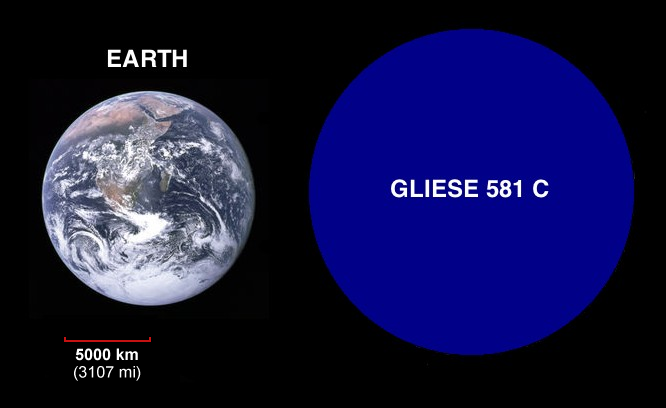
The announcement today of two newfound alien planets circling the star Gliese 581 adds to the nearby solar system's intrigue, further cementing its status as a top candidate to harbor extraterrestrial life.
Subscribe to:
Posts (Atom)


 Posts
Posts

