
Showing posts with label Relaxing. Show all posts
Showing posts with label Relaxing. Show all posts
Sunday, June 12, 2011
Rhythm of Mankind & Nature - The Mystery of Harmony


Saturday, May 14, 2011
Zenattitude - Nautilus
Original Release Date: 9 April 2002
Label: Essential Media Group
Nautilus (from Greek ναυτίλος, 'sailor') is the common name of marine creatures of cephalopod family Nautilidae, the sole extant family of the superfamily Nautilaceae and of its smaller but near equal suborder, Nautilina. It comprises six living species in two genera, the type of which is the genus Nautilus. Though it more specifically refers to species Nautilus pompilius, the name chambered nautilus is also used for any species of the Nautilidae.
Nautilidae, both extant and extinct, are characterized by involute or slightly evolute shells that are generally smooth, with compressed or depressed whorl sections, straight to sinuous sutures, and a tubular, generally central siphuncle.[2] Having survived relatively unchanged for millions of years, nautiluses represent the only living members of the subclass Nautiloidea, and are often considered "living fossils."
The name "Nautilus" originally referred to the Argonauta, otherwise known as paper nautiluses, because the ancients believed these animals used their two expanded arms as sails (cf. Aristotle Historia Animalium 622b). However, this octopus is not closely related to the Nautiloidea.Source

Tuesday, January 25, 2011
Self Regression. Who were you in a Past Life?
Source
Friday, January 01, 2010
Christmas tree
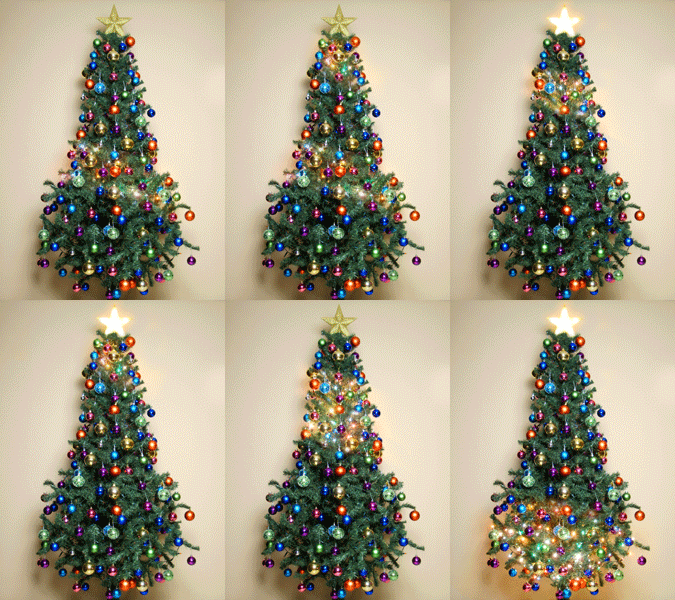
The Christmas tree is a decorated evergreen coniferous tree, real or artificial, and a tradition associated with the celebration of Christmas or the original name Yule. The Christmas tree is often brought into a home, but can also be used in the open, and can be decorated with Christmas lights (originally candles), ornaments, garlands and tinsel during the days around Christmas. An angel or star is often placed at the top of the tree, representing the host of angels or the Star of Bethlehem from the Nativity.
History
The ancient pagans, Druids, Egyptians, and Chinese, celebrated the Winter Solstice, (Dec. 21st), the day of the year that the Sun begins its ascent in the sky, thereby ushering a fertile time of planting and bountiful harvests. Hence, the evergreen tree represented eternal life and the promise of replenishment during the cold winter months[citation needed]. Apples and other fruit were hung upon the tree to represent the plentiful food to come. Candles were lighted to symbolize the warmth and brightness of the sun. While the Christmas tree is generally associated with Christ, it predates this religious figure by many centuries.
Later in history Germans hung wafers on the tree along with the apples to represent the sacrifice of Jesus on the cross. In the Victorian era, the apples were replaced by red glass balls and candles and the representation signified both Adam and Eve along with the fire of life. Moreover, the Christmas tree was also used to scare away evil forces for the new year.
The ancient pagans, Druids, Egyptians, and Chinese, celebrated the Winter Solstice, (Dec. 21st), the day of the year that the Sun begins its ascent in the sky, thereby ushering a fertile time of planting and bountiful harvests. Hence, the evergreen tree represented eternal life and the promise of replenishment during the cold winter months[citation needed]. Apples and other fruit were hung upon the tree to represent the plentiful food to come. Candles were lighted to symbolize the warmth and brightness of the sun. While the Christmas tree is generally associated with Christ, it predates this religious figure by many centuries.
Later in history Germans hung wafers on the tree along with the apples to represent the sacrifice of Jesus on the cross. In the Victorian era, the apples were replaced by red glass balls and candles and the representation signified both Adam and Eve along with the fire of life. Moreover, the Christmas tree was also used to scare away evil forces for the new year.
After the beginning of the New Year, January 1, the Pagans would take the chopped decorated Christmas tree down and burn the "Yule" log in remembrance of the past year. They would rejoice in song and dance for the goals that have been completed and in jubilation for the coming of the Spring and life. Furthermore, New Year's resolutions were constructed at a later date from the Pagans setting of the goals.
Origin
According to Christian lore, the Christmas tree is associated with St Boniface and the German town of Geismar. Sometime in St Boniface's lifetime (c. 672-754) he cut down the tree of Thor in order to disprove the legitimacy of the Norse gods to the local German tribe. St. Boniface saw a fir tree growing in the roots of the old oak. Taking this as a sign of the Christian faith, he said "...let Christ be at the center of your households..." using the fir tree as a symbol of Christianity.
According to Christian lore, the Christmas tree is associated with St Boniface and the German town of Geismar. Sometime in St Boniface's lifetime (c. 672-754) he cut down the tree of Thor in order to disprove the legitimacy of the Norse gods to the local German tribe. St. Boniface saw a fir tree growing in the roots of the old oak. Taking this as a sign of the Christian faith, he said "...let Christ be at the center of your households..." using the fir tree as a symbol of Christianity.
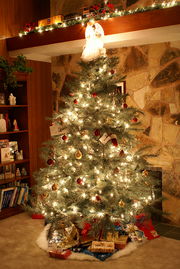
An artificial Christmas tree inside a home.
The custom of erecting a Christmas Tree can be historically traced to 16th century Northern Germany and the Baltic region, though neither an inventor nor a single town can be identified as the sole origin for the tradition. According to the first documented uses of a Christmas tree in Estonia, in 1441, 1442, and 1514 the Blackheads erected a tree for the holidays in their brotherhood house in Tallinn. At the last night of the celebrations leading up to the holidays, the tree was taken to the Town Hall Square where the members of the brotherhood danced around it. In 1584, the Estonian chronicler Balthasar Russow wrote of an established tradition of setting up a decorated spruce at the market square where the young men “went with a flock of maidens and women, first sang and danced there and then set the tree aflame”.
The custom of erecting a Christmas Tree can be historically traced to 16th century Northern Germany and the Baltic region, though neither an inventor nor a single town can be identified as the sole origin for the tradition. According to the first documented uses of a Christmas tree in Estonia, in 1441, 1442, and 1514 the Blackheads erected a tree for the holidays in their brotherhood house in Tallinn. At the last night of the celebrations leading up to the holidays, the tree was taken to the Town Hall Square where the members of the brotherhood danced around it. In 1584, the Estonian chronicler Balthasar Russow wrote of an established tradition of setting up a decorated spruce at the market square where the young men “went with a flock of maidens and women, first sang and danced there and then set the tree aflame”.
The first documented use of an evergreen tree in a Christmas celebration is from Riga, Latvia, in the year 1510. The legend says that the first Riga tree was decorated with paper flowers and burnt on the bonfire after the ceremony. In that period, the guilds started erecting Christmas trees in front of their guildhalls: Ingeborg Weber-Kellermann (Marburg professor of European ethnology) found a Bremen guild chronicle of 1570 which reports how a small tree was decorated with "apples, nuts, dates, pretzels and paper flowers" and erected in the guild-house, for the benefit of the guild members' children, who collected the dainties on Christmas Day. Another early reference is from Basel, where the tailor apprentices carried around town a tree decorated with apples and cheese in 1597.
18th and 19th century
By the early 18th century, the custom had become common in towns of the upper Rhineland, but it had not yet spread to rural areas. Wax candles are attested from the late 18th century. The Christmas tree remained confined to the upper Rhineland for a relatively long time. It was regarded as a Protestant custom by the Roman Catholic majority along the lower Rhine and was spread there only by Prussian officials who were moved there in the wake of the Congress of Vienna in 1815. Just like Christmas (Germanic Yuletide), the Christmas tree was more or less accepted by the Roman Catholic Church because it could not prevent its use.
The tradition was introduced to Canada in the winter of 1781 by Brunswick soldiers stationed in the Province of Quebec to garrison the colony against American attack. General Friedrich Adolf Riedesel and his wife, the Baroness von Riedesel, held a Christmas party at Sorel, delighting their guests with a fir tree decorated with candles and fruits.
By the early 18th century, the custom had become common in towns of the upper Rhineland, but it had not yet spread to rural areas. Wax candles are attested from the late 18th century. The Christmas tree remained confined to the upper Rhineland for a relatively long time. It was regarded as a Protestant custom by the Roman Catholic majority along the lower Rhine and was spread there only by Prussian officials who were moved there in the wake of the Congress of Vienna in 1815. Just like Christmas (Germanic Yuletide), the Christmas tree was more or less accepted by the Roman Catholic Church because it could not prevent its use.
The tradition was introduced to Canada in the winter of 1781 by Brunswick soldiers stationed in the Province of Quebec to garrison the colony against American attack. General Friedrich Adolf Riedesel and his wife, the Baroness von Riedesel, held a Christmas party at Sorel, delighting their guests with a fir tree decorated with candles and fruits.
In the early 19th century, the custom became popular among the nobility and spread to royal courts as far as Russia. Princess Henrietta of Nassau-Weilburg introduced the Christmas tree to Vienna in 1816, and the custom spread across Austria in the following years. In France, the first Christmas tree was introduced in 1840 by the duchesse d'Orléans.
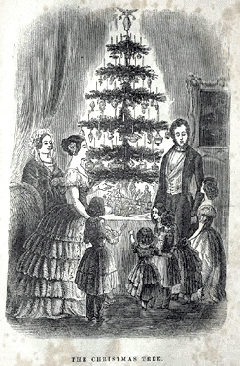
The Queen's Christmas tree at Windsor Castle, 1848. Republished in Godey's Lady's Book, Philadelphia December, 1850. Victoria's crown, Prince Albert's mustache edited.
In Britain, the Christmas tree was introduced in the time of the personal union with Hanover, by George III's Queen Charlotte of Mecklenburg-Strelitz in early 1800s, but the custom hadn't yet spread much beyond the royal family. Queen Victoria as a child was familiar with the custom. In her journal for Christmas Eve 1832, the delighted 13-year-old princess wrote, "After dinner...we then went into the drawing-room near the dining-room...There were two large round tables on which were placed two trees hung with lights and sugar ornaments. All the presents being placed round the trees..". After her marriage to her German cousin Prince Albert, by 1841 the custom became even more widespread throughout Britain. In 1847, Prince Albert wrote: "I must now seek in the children an echo of what Ernest [his brother] and I were in the old time, of what we felt and thought; and their delight in the Christmas-trees is not less than ours used to be".
A woodcut of the British Royal family with their Christmas tree at Windsor Castle, initially published in the Illustrated London News December 1848, was copied in the United States at Christmas 1850, in Godey's Lady's Book (illustration, left). Godey's copied it exactly, except for the removal of the Queen's crown and Prince Albert's mustache, to remake the engraving into an American scene. The republished Godey's image became the first widely circulated picture of a decorated evergreen Christmas tree in America. Art historian Karal Ann Marling called Prince Albert and Queen Victoria, shorn of their royal trappings, "the first influential American Christmas tree". Folk-culture historian Alfred Lewis Shoemaker states, "In all of America there was no more important medium in spreading the Christmas tree in the decade 1850-60 than Godey's Lady's Book". The image was reprinted in 1860, and by the 1870s, putting up a Christmas tree had become common in America.
Several cities in the United States with German connections lay claim to that country's first Christmas tree: Windsor Locks, Connecticut, claims that a Hessian soldier put up a Christmas tree in 1777 while imprisoned at the Noden-Reed House, while the "First Christmas Tree in America" is also claimed by Easton, Pennsylvania, where German settlers purportedly erected a Christmas tree in 1816. In his diary, Matthew Zahm of Lancaster, Pennsylvania, recorded the use of a Christmas tree in 1821, leading Lancaster to also lay claim to the first Christmas tree in America. Other accounts credit Charles Follen, a German immigrant to Boston, for being the first to introduce to America the custom of decorating a Christmas tree. August Imgard, a German immigrant living in Wooster, Ohio, is the first to popularise the practice of decorating a tree with candy canes. In 1847, Imgard cut a blue spruce tree from a woods outside town, had the Wooster village tinsmith construct a star, and placed the tree in his house, decorating it with paper ornaments and candy canes. The National Confectioners' Association officially recognises Imgard as the first ever to put candy canes on a Christmas tree; the canes were all-white, with no red stripes. Imgard is buried in the Wooster Cemetery, and every year, a large pine tree above his grave is lit with Christmas lights. German immigrant Charles Minnegerode accepted a position as a professor of humanities at the College of William and Mary in Williamsburg in 1842, where he taught Latin and Greek. Entering into the social life of the Virginia Tidewater, Minnigerode introduced the German custom of decorating an evergreen tree at Christmas at the home of law professor St. George Tucker, thereby becoming another of many influences that prompted Americans to adopt the practice at about that time.
20th century
Many cities, towns, and department stores put up public Christmas trees outdoors, such as the Rich's Great Tree in Atlanta, the Rockefeller Center Christmas Tree in New York City and the large Christmas tree at Victoria Square in Adelaide. During most of the 1970s and 1980s, the largest Christmas tree in the world was put up every year on the property of The National Enquirer in Lantana, Florida. This tradition grew into one of the most spectacular and celebrated events in the history of southern Florida, but was discontinued on the death of the paper's founder in the late 1980s.
Many cities, towns, and department stores put up public Christmas trees outdoors, such as the Rich's Great Tree in Atlanta, the Rockefeller Center Christmas Tree in New York City and the large Christmas tree at Victoria Square in Adelaide. During most of the 1970s and 1980s, the largest Christmas tree in the world was put up every year on the property of The National Enquirer in Lantana, Florida. This tradition grew into one of the most spectacular and celebrated events in the history of southern Florida, but was discontinued on the death of the paper's founder in the late 1980s.
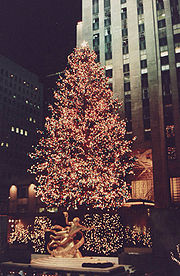
In some cities, a Festival of Trees is organised around the decoration and display of multiple trees as charity events. In some cases the trees represent special commemorative gifts, such as in Trafalgar Square in London, where the City of Oslo, Norway presents a tree to the people of London as a token of appreciation for the British support of Norwegian resistance during the Second World War; in Boston, where the tree is a gift from the province of Nova Scotia, in thanks for rapid deployment of supplies and rescuers to the 1917 ammunition ship explosion that levelled the city of Halifax; and in Newcastle upon Tyne, where the 15 m-tall main civic Christmas tree is an annual gift from the city of Bergen, Norway, in thanks for the part played by soldiers from Newcastle in liberating Bergen from Nazi occupation. Norway also annually gifts a Christmas tree to Washington D.C. as a symbol of friendship between Norway and the US and as an expression of gratitude from Norway for the help received from the US during World War II.

Taiwanese aboriginals, tutored by Christian missionaries, celebrate with trees
(Cunninghamia lanceolata) outside their homes.
(Cunninghamia lanceolata) outside their homes.
The United States' National Christmas Tree is lit each year on the South Lawn of the White House. Today, the lighting of the National Christmas Tree is part of what has become a major holiday event at the White House. President Jimmy Carter lit only the crowning star atop the Tree in 1979 in honour of the Americans being held hostage in Iran. The same was true in 1980, except the tree was fully lit for 417 seconds, one second for each day the hostages had been in captivity.
The term Charlie Brown Christmas tree is used in the United States and Canada to describe any poor-looking or malformed little tree. Some tree buyers intentionally adopt such trees, feeling sympathetic to their plights. The term comes from the appearance of Charlie Brown's Christmas tree in the TV special A Charlie Brown Christmas.
In New Zealand, Pōhutukawa trees are described as "native Christmas trees", as they bloom at Christmas time, and look like Christmas trees with their red flowers and green foliage.

New Year tree decoration depicting cosmonaut (USSR, 1960s)
In Russia, the Christmas tree was banned shortly after the October Revolution but then reinstated as a New-year fir-tree (Новогодняя ёлка) in 1935. It became a fully secular icon of the New year holiday, e.g. the crowning star was regarded not as a symbol of Bethlehem Star, but as the Red Star. Decorations, such as figurines of airplanes, bicycles, space rockets, cosmonauts, and characters of Russian fairy tales, were produced. This tradition persists after the fall of the USSR, with the New Year holiday outweighting the Christmas (7 January) for a wide majority of Russians.
Dates
Both setting up and taking down a Christmas tree are associated with specific dates. Traditionally, Christmas trees were not brought in and decorated until Christmas Eve (24 December) or, in the traditions celebrating Christmas Eve rather than first of day of Christmas, the 23 December, and then removed the day after twelfth night (6 January); to have a tree up before or after these dates was even considered bad luck.
Both setting up and taking down a Christmas tree are associated with specific dates. Traditionally, Christmas trees were not brought in and decorated until Christmas Eve (24 December) or, in the traditions celebrating Christmas Eve rather than first of day of Christmas, the 23 December, and then removed the day after twelfth night (6 January); to have a tree up before or after these dates was even considered bad luck.
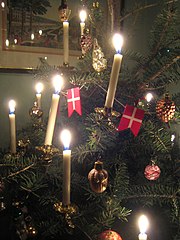
Christmas trees lit by candles, Denmark.

A giant Christmas Tree in SM Mall Of Asia,Pasay City,Philippines.
Modern commercialization of Christmas has resulted in trees being put up much earlier; in shops often as early as late October — in the UK, Selfridges's Christmas department is up by early September, complete with Christmas trees, and in New York City, street Christmas tree vendors set up their stands shortly after Thanksgiving. Some households in the U.S. do not put up the tree until the second week of December, and leave it up until the 6th of January (Epiphany). In Germany, traditionally the tree is put up on the 24th of December and taken down on the 7th of January, though many start one or two weeks earlier, and in Roman Catholic homes the tree may be kept until late January. In Australia, the Christmas tree is usually put up on the 1st of December, which occurs about a week before the school summer holidays; except for South Australia, where most people put up their tree after the Adelaide Credit Union Christmas Pageants in early December.[citation needed] Some traditions suggest that Christmas trees may be kept up until no later than the 2nd of February, the feast of the Presentation of Jesus in the Temple (Candlemas), when the Christmas season effectively closes. Superstitions say it's a bad sign if Christmas greenery is not removed by Candle mas Eve.
Natural trees
The most commonly used species are fir (Abies), which have the benefit of not shedding their needles when they dry out, as well as retaining good foliage colour and scent; but species in other genera are also used.
In northern Europe most commonly used are:
* Silver Fir Abies alba (the original species)
* Nordmann Fir Abies nordmanniana (as in the photo)
* Noble Fir Abies procera
* Norway Spruce Picea abies (generally the cheapest)
* Serbian Spruce Picea omorika
* Scots Pine Pinus sylvestris
* Stone Pine Pinus pinea (as small table-top trees)
* Swiss Pine Pinus cembra
In North America, Central America and South America most commonly used are:
* Douglas-fir Pseudotsuga menziesii
* Balsam Fir Abies balsamea
* Fraser Fir Abies fraseri
* Grand Fir Abies grandis
* Guatemalan Fir Abies guatemalensis
* Noble Fir Abies procera
* Red Fir Abies magnifica
* White Fir Abies concolor
* Pinyon Pine Pinus edulis
* Jeffrey Pine Pinus jeffreyi
* Scots Pine Pinus sylvestris
* Stone Pine Pinus pinea (as small table-top trees)
* Norfolk Island Pine Araucaria heterophylla
Several other species are used to a lesser extent. Less-traditional conifers are sometimes used, such as Giant Sequoia, Leyland Cypress, Monterey Cypress and Eastern Juniper. Various types of spruce tree are also used for Christmas trees (including the Blue Spruce and, less commonly, the White Spruce); but spruces (unlike firs) begin to lose their needles rapidly upon being cut, and spruce needles are often sharp, making decorating uncomfortable. Virginia Pine is still available on some tree farms in the southeastern United States, however its winter colour is faded. The long-needled Eastern White Pine is also used there, though it is an unpopular Christmas tree in most parts of the country, owing also to its faded winter coloration and limp branches, making decorating difficult with all but the lightest ornaments. Norfolk Island Pine is sometimes used, particularly in Oceania, and in Australia some species of the genera Casuarina and Allocasuarina are also occasionally used as Christmas trees but by far the most common tree is the Monterey Pine. Adenanthos sericeus or Albany Woolly Bush is commonly sold in southern Australia as a potted living Christmas tree. Hemlock species are generally considered unsuitable as Christmas trees due to their poor needle retention and inability to support the weight of lights and ornaments.
Some trees, frequently referred to as Living Christmas trees, are sold live with roots and soil, often from a nursery, to be stored at nurseries in planters or planted later outdoors and enjoyed (and often decorated) for years or decades. Others are produced in a container and sometimes as topiary for a porch or patio. However, when done improperly, the combination of root loss caused by digging, and the indoor environment of high temperature and low humidity is very detrimental to the tree's health; additionally, the warmth of an indoor climate will bring the tree out of its natural winter dormancy, leaving it little protection when put back outside into a cold outdoor climate. Thus, the survival rate of these trees is low. However, replanting when done properly provides higher survival rates.
In northern Europe most commonly used are:
* Silver Fir Abies alba (the original species)
* Nordmann Fir Abies nordmanniana (as in the photo)
* Noble Fir Abies procera
* Norway Spruce Picea abies (generally the cheapest)
* Serbian Spruce Picea omorika
* Scots Pine Pinus sylvestris
* Stone Pine Pinus pinea (as small table-top trees)
* Swiss Pine Pinus cembra
In North America, Central America and South America most commonly used are:
* Douglas-fir Pseudotsuga menziesii
* Balsam Fir Abies balsamea
* Fraser Fir Abies fraseri
* Grand Fir Abies grandis
* Guatemalan Fir Abies guatemalensis
* Noble Fir Abies procera
* Red Fir Abies magnifica
* White Fir Abies concolor
* Pinyon Pine Pinus edulis
* Jeffrey Pine Pinus jeffreyi
* Scots Pine Pinus sylvestris
* Stone Pine Pinus pinea (as small table-top trees)
* Norfolk Island Pine Araucaria heterophylla
Several other species are used to a lesser extent. Less-traditional conifers are sometimes used, such as Giant Sequoia, Leyland Cypress, Monterey Cypress and Eastern Juniper. Various types of spruce tree are also used for Christmas trees (including the Blue Spruce and, less commonly, the White Spruce); but spruces (unlike firs) begin to lose their needles rapidly upon being cut, and spruce needles are often sharp, making decorating uncomfortable. Virginia Pine is still available on some tree farms in the southeastern United States, however its winter colour is faded. The long-needled Eastern White Pine is also used there, though it is an unpopular Christmas tree in most parts of the country, owing also to its faded winter coloration and limp branches, making decorating difficult with all but the lightest ornaments. Norfolk Island Pine is sometimes used, particularly in Oceania, and in Australia some species of the genera Casuarina and Allocasuarina are also occasionally used as Christmas trees but by far the most common tree is the Monterey Pine. Adenanthos sericeus or Albany Woolly Bush is commonly sold in southern Australia as a potted living Christmas tree. Hemlock species are generally considered unsuitable as Christmas trees due to their poor needle retention and inability to support the weight of lights and ornaments.
Some trees, frequently referred to as Living Christmas trees, are sold live with roots and soil, often from a nursery, to be stored at nurseries in planters or planted later outdoors and enjoyed (and often decorated) for years or decades. Others are produced in a container and sometimes as topiary for a porch or patio. However, when done improperly, the combination of root loss caused by digging, and the indoor environment of high temperature and low humidity is very detrimental to the tree's health; additionally, the warmth of an indoor climate will bring the tree out of its natural winter dormancy, leaving it little protection when put back outside into a cold outdoor climate. Thus, the survival rate of these trees is low. However, replanting when done properly provides higher survival rates.
European tradition prefers the open aspect of naturally-grown, unsheared trees, while in North America (outside western areas where trees are often wild-harvested on public lands there is a preference for close-sheared trees with denser foliage, but less space to hang decorations.
In the past, Christmas trees were often harvested from wild forests, but now almost all are commercially grown on tree farms. Almost all Christmas trees in the United States are grown on Christmas tree farms where they are cut after about ten years of growth and new trees planted. According to the United States Department of Agriculture (USDA) agriculture census for 2002 (the census is done every five years) there were 21,904 farms were producing conifers for the cut Christmas tree market in America, 180,897 hectares (447,006 acres) were planted in Christmas trees, and 13,849 farms harvested cut trees. The top 5 percent of the farms (40 hectares / 100 acres or more) sold 61 percent of the trees. The top 26 percent of the farms (8 hectares / 20 acres or more) sold 84 percent of the trees. Farms less than 0.8 hectare (two acres) comprised 21 percent of the farms, and sold an average of 115 trees per farm.

A tree with fibre optic lights
The life cycle of a Christmas tree from the seed to a 2-metre (7 ft) tree takes, depending on species and treatment in cultivation, between 8 and 12 years. First, the seed is extracted from cones harvested from older trees. These seeds are then usually grown in nurseries and then sold to Christmas tree farms at an age of 3–4 years. The remaining development of the tree greatly depends on the climate, soil quality, as well as the cultivation and tendance by the Christmas tree farmer.
Artificial trees
The first artificial Christmas trees were developed in Germany during the 19th century though earlier examples exist. These "trees" were made using goose feathers that were dyed green. The German feather trees were one response by Germans to continued deforestation in Germany. Feather Christmas trees ranged widely in size, from a small 2-inch (51 mm) tree to a large 98-inch (2,500 mm) tree sold in department stores during the 1920s. Often, the tree branches were tipped with artificial red berries which acted as candle holders.
The first artificial Christmas trees were developed in Germany during the 19th century though earlier examples exist. These "trees" were made using goose feathers that were dyed green. The German feather trees were one response by Germans to continued deforestation in Germany. Feather Christmas trees ranged widely in size, from a small 2-inch (51 mm) tree to a large 98-inch (2,500 mm) tree sold in department stores during the 1920s. Often, the tree branches were tipped with artificial red berries which acted as candle holders.

A vintage aluminium tree, lit by a rotating colour wheel.
Over the years, other styles of artificial Christmas trees have evolved and become popular. In 1930, the U.S.-based Addis Brush Company created the first artificial Christmas tree made from brush bristles. Another type of tree, the aluminum Christmas tree, is made from aluminum. The trees were manufactured in the United States, first in Chicago in 1958, and later in Manitowoc, Wisconsin, where the majority of the trees were produced. Most modern artificial Christmas trees are made from 100% recycled plastics of used packaging materials, such as polyvinyl chloride (PVC) or other plastics. Approximately 10% of artificial Christmas trees are using virgin suspension PVC resin and despite being plastic most artificial trees are not recyclable or biodegradable.
Other gimmicks have developed as well. Fiber optic Christmas trees come in two major varieties, one resembles a traditional Christmas tree. One Dallas-based company offers "holographic mylar" trees in many hues. Tree-shaped objects made from such materials as cardboard, glass, ceramic or other materials can be found in use as tabletop decorations. Upside-down artificial Christmas trees became popular for a short time and were originally introduced as a marketing gimmick; they allowed consumers to get closer to ornaments for sale in retail stores as well as opened up floor space for more products.
Artificial trees became increasingly popular during the late 20th century. Users of artificial Christmas trees assert that they are more convenient, and, because they are reusable, much cheaper than their natural alternative. Between 2001 and 2007 artificial Christmas tree sales jumped from 7.3 million to 17.4 million.
Other gimmicks have developed as well. Fiber optic Christmas trees come in two major varieties, one resembles a traditional Christmas tree. One Dallas-based company offers "holographic mylar" trees in many hues. Tree-shaped objects made from such materials as cardboard, glass, ceramic or other materials can be found in use as tabletop decorations. Upside-down artificial Christmas trees became popular for a short time and were originally introduced as a marketing gimmick; they allowed consumers to get closer to ornaments for sale in retail stores as well as opened up floor space for more products.
Artificial trees became increasingly popular during the late 20th century. Users of artificial Christmas trees assert that they are more convenient, and, because they are reusable, much cheaper than their natural alternative. Between 2001 and 2007 artificial Christmas tree sales jumped from 7.3 million to 17.4 million.
Source

Sunday, December 13, 2009
Ambient Music Video
Go Here for more info: http://www.diatonis.com/trajectories.html
Go Here for more info: http://www.diatonis.com/ambient_life.html
Go Here for more info: http://www.diatonis.com/ambient_life.html
Saturday, December 05, 2009
Welcome to the Global Consciousness Project Dot
Source
The Global Consciousness Project collects random numbers from around the world. These numbers are available on the GCP website. This website downloads those numbers once a minute and performs sophisticated analysis on these random numbers to see how coherent they are. That is, how probable it is that the numbers are generated as they are. The theory is that the Global Consciousness of all the people of the world affect these random numbers... Maybe they aren't quite as random as we thought.
The probability time window is one hour. For a more information on the algorithm you can read about it on the GCP Basic Science page
Background Music from Jonathan Goldman
Ultimate OM Jonathan Goldman
The Global Consciousness Project collects random numbers from around the world. These numbers are available on the GCP website. This website downloads those numbers once a minute and performs sophisticated analysis on these random numbers to see how coherent they are. That is, how probable it is that the numbers are generated as they are. The theory is that the Global Consciousness of all the people of the world affect these random numbers... Maybe they aren't quite as random as we thought.
The probability time window is one hour. For a more information on the algorithm you can read about it on the GCP Basic Science page
Background Music from Jonathan Goldman
Ultimate OM Jonathan Goldman
Tuesday, November 24, 2009
Monday, November 23, 2009
Life After Life
Life After Life - The most amazing bloopers are here
Source
Tuesday, November 17, 2009
Saturday, August 29, 2009
Roman Pavlov - Relaxing Ambient Music
ROM&N by Roman Pavlov
The musical project «Rhythm of Mankind & Nature» was founded in 2000. Its purpose was creating the mood music able to heighten the listener’s perception of the surrounding World. Composed as based on electronic sounding, the music is harmoniously supplemented by live instruments and vocal, creating both melancholic, warm, gentle pieces causing delight, the feeling of flight, cosiness and comfort and depressive melodies able to remind one of complicated life problems.
In 2003 the project founder, a Russian composer/producer Roman Pavlov, concluded a contract with the English publishing house – Label Raw42. The result of cooperation was the release of album Relax – collected compositions in discs Raw42 and BE52 Records, as well as the advertising of Isabella Rossellini perfume.
From 2006 Roman has organized own small label ROMAN Music Records for a narrow circle of composers, and has signed the contract with distributor Isolation Network Electronic Music / BMI, San-Francisco, USA.
The musical project «Rhythm of Mankind & Nature» was founded in 2000. Its purpose was creating the mood music able to heighten the listener’s perception of the surrounding World. Composed as based on electronic sounding, the music is harmoniously supplemented by live instruments and vocal, creating both melancholic, warm, gentle pieces causing delight, the feeling of flight, cosiness and comfort and depressive melodies able to remind one of complicated life problems.
In 2003 the project founder, a Russian composer/producer Roman Pavlov, concluded a contract with the English publishing house – Label Raw42. The result of cooperation was the release of album Relax – collected compositions in discs Raw42 and BE52 Records, as well as the advertising of Isabella Rossellini perfume.
From 2006 Roman has organized own small label ROMAN Music Records for a narrow circle of composers, and has signed the contract with distributor Isolation Network Electronic Music / BMI, San-Francisco, USA.
Saturday, August 22, 2009
Subscribe to:
Posts (Atom)


 Posts
Posts

