Physicists created a new quantum theorem for entropy, and included is a possible exception.
The Second Law of Thermodynamics says that entropy in the universe must always increase. It's an immutable law of physics, and it's the reason you can't get free energy or perpetual motion machines. But a group of physicists may have found a way to break this law, at least in some specific circumstances.
The researchers, from Argonne National Laboratory, have developed a theoretical model where the Second Law is violated on a molecular level. Their results are published in the journal Science Direct.
The basic idea behind the discovery is the H-theorem, which says if you mix a hot thing and a cold thing, the mixture will end up somewhere in the middle. The H-theorem relies on a statistical interpretation of the way molecules move around. Because it's pretty much impossible to keep track of every single molecule, physicists just treat them as groups and use statistics to figure out how they'll behave.
The team from Argonne decided to look at the problem through the lens of quantum mechanics. They created a quantum H-theorem that is, at least theoretically, more accurate than the traditional theorem. Their new formula revealed that in some special cases, entropy might actually decrease, at least in the short term.
A few years before Boltzmann proposed his H-theorem, another physicist had an idea for a way to cheat the Second Law. James Clerk Maxwell proposed a hypothetical thought experiment: What if a small demon sat between the hot and cold things and controlled their mixing? The demon would only allow hot things to go one way and cold things to go another. Essentially, the demon could unmix the mixture.
It turns out that this doesn't actually violate the Second Law because the demon creates more entropy than it eliminates. Today, we use electricity to play this role, unmixing hot and cold things with our air conditioners and refrigerators. But the researchers' model suggests a quantum demon that could actually violate the Second Law.
This is all theoretical, of course. But if the theory pans out, quantum demons might someday power our air conditioners and refrigerators, saving you electricity and cheating the current laws of physics at the same time.
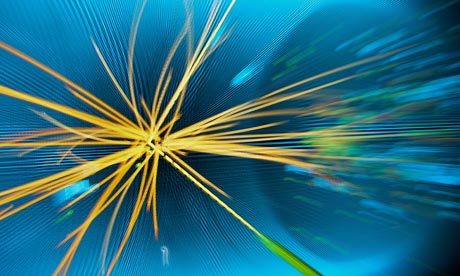
Proton-proton collisions as measured by the European Organisation for Nuclear Research (Cern) in its search for the Higgs boson particle. Photograph: Fabrice Coffrini/AFP/Getty Images
The search for the arcane, theoretical particle known as the Higgs boson has drawn on the world's largest scientific instruments and occupied thousands of researchers over more than two decades. The discovery – or probable discovery – at Cern, the particle physics lab near Geneva, will go down as a triumph of science, engineering and collective hard graft. Now the real work begins.
Physicists say they have all but proven that the "God particle" exists. They have a footprint and a shadow, and the only thing left is to see for themselves the elusive subatomic particle believed to give all matter in the universe size and shape.
The divine spark? The Big Bang exploded our universe into existence - but astrophysicists say there is no need for a God to be involved in the process
You do not need God to fill in the blanks of the Big Bang, says an astrophysicist.
That isn't to say there is no God, simply that the universe is explainable without the need for a divine being to bring something out of nothing, says Alex Flippenko, of the University of California.
THINK for a moment about a time before you were born. Where were you? Now think ahead to a time after your death. Where will you be? The brutal answer is: nowhere. Your life is a brief foray on Earth that started one day for no reason and will inevitably end.
But what a foray. Like the whole universe, your consciousness popped into existence out of nothingness and has evolved into a rich and complex entity full of wonder and mystery.
NDERF Is the largest Near Death Experience Website in the world with over 2500 full-text published NDE accounts
Here are our newest experiences:
DISCLAIMER: NDERF has posted suicide NDEs on the website as part of the research project ONLY. NDERF DOES NOT ENDORSE, ENCOURAGE OR ADVOCATE FOR SUICIDE IN ANY WAY, SHAPE OR FORM!
Based on Hyperdimensional Physics, Hoagland successfully predicted the historic results of this election almost two years ago! In this production, based on further application of this HD Model, Hoagland now presents never-before-seen clues to what America and the world may expect from this incoming, unique "Hyperdimensional Obama Administration" -- including, what Barack Obama may finally do with NASA's decades of classified data on intelligent artifacts discovered on the Moon and Mars, as well as what could be in store for all of us at the end of Obama's first term ... in "2012."
A new photonic chip that works on light rather than electricity has been built by an international research team, paving the way for the production of ultra-fast quantum computers with capabilities far beyond today’s devices.
Future quantum computers will, for example, be able to pull important information out of the biggest databases almost instantaneously. As the amount of electronic data stored worldwide grows exponentially, the technology will make it easier for people to search with precision for what they want.
An early application will be to investigate and design complex molecules, such as new drugs and other materials, that cannot be simulated with ordinary computers. More general consumer applications should follow.
Jeremy O’Brien, director of the UK’s Centre for Quantum Photonics, who led the project, said many people in the field had believed a functional quantum computer would not be a reality for at least 25 years.
“However, we can say with real confidence that, using our new technique, a quantum computer could, within five years, be performing calculations that are outside the capabilities of conventional computers,” he told the British Science Festival, as he presented the research.
The breakthrough, published today in the journal Science, means data can be processed according to the counterintuitive rules of quantum physics that allow individual subatomic particles to be in several places at the same time.
This property will enable quantum computers to process information in quantities and at speeds far beyond conventional supercomputers. But formidable technical barriers must be overcome before quantum computing becomes practical.
The team, from Bristol university in the UK, Tohuku university in Japan, Weizmann Institute in Israel and Twente university in the Netherlands, say they have overcome an important barrier, by making a quantum chip that can work at ordinary temperatures and pressures, rather than the extreme conditions required by other approaches.
The immense promise of quantum computing has led governments and companies worldwide to invest hundreds of millions of dollars in the field.
Big spenders, including the US defence and intelligence agencies concerned with the national security issues, and governments – such as Canada, Australia and Singapore – see quantum electronics as the foundation for IT industries in the mid-21st century.
Computing’s great leap forward
Why quantum computing?
To make use of properties that emerge on an ultra-small scale. “Entanglement” – the ability of subatomic particles to influence one another at a distance – and “superposition” – the fact that a particle does not have a definite location and can be in several places at once – are the two most important properties.
Yes, it’s weird but why is it useful?
Because quantum particles can do very many things at the same time, unlike an electronic “bit” in conventional computing. The use of quantum particles, or “qubits”, permits parallel computing on a scale that would not be possible with conventional electronics.
What particles are you talking about?
Many scientists are working with atoms or ions trapped in ultra-cold conditions. But the latest discovery by the Bristol-led team uses photons – light particles.
How does a quantum chip actually work?
There are several models. The Bristol version sends “entangled” photons down networks of circuits in a silicon chip. The particles perform a co-ordinated “quantum walk”, whose outcome represents the results of a calculation. Of course, special software and input-output devices will have to be developed to make practical use of the device.
Quantum physicists at the Massachusetts Institute of Technology believe
it is possible to create a time machine which could affect the past without
creating a "grandfather paradox".
How the quantum time machine may look. Or, possibly, a still from Back to the Future.
Photo: UNIVERSAL STUDIOS
Scientists have for some years been able to 'teleport' quantum states from one place to another. Now Seth Lloyd and his MIT team say that, using the same principles and a further strange quantum effect known as 'postselection', it should be possible to do the same backwards in time. Lloyd told the Technology Review: "It is possible for particles (and, in principle, people) to tunnel from the future to the past."
Postselection is a vital part of the nascent science of quantum computing. In traditional computing, if a user needs to determine which set of variables in an equation leads to the answer being true, the computer must try every combination until it hits upon one that works. In quantum computing, due to the weird parallel behaviour of subatomic particles, it seems to be possible to simplify the procedure by running all possible variations simultaneously, and selecting only the combinations that make the answer true.
Professor Lloyd and his team say that, by combining teleportation and postselection, it would be possible to carry out the quantum teleportation effect in reverse; that is, to decide after the teleportation what the quantum state must have been before it. This works as postselection allows you to dictate which quantum states can be teleported, limiting what state it can have been in before the teleportation. The state of the particle post-teleportation has therefore, in effect, travelled back in time.
Dr Richard Low, a quantum computing scientist from the University of Bristol, says: "You could think of it as postselection affecting the history of the particle, sending the state back in time."
Unlike previous theories of teleportation, this apparently avoids the "grandfather paradox" - or, to Back to the Future fans, the Marty McFly problem. If you go back and change time, and accidentally end up killing your own grandparent, you create a paradox - you will not be born, so you cannot go back and affect time. Even with subatomic particles, this is still a problem: upon travelling back in time, the particle could somehow destroy its earlier self or move it, thus preventing it from travelling.
However, because of the probabilistic nature of quantum mechanics, Prof Lloyd's method seems to avoid this. Anything caused by the time travel must have had a finite probability of happening anyway, so paradoxical impossibilities are out.
Further, this time travel method does not involve bending spacetime, unlike other proposed systems. At the moment, the only conditions known that would bend spacetime sufficiently exist in black holes, which would be impractical at best.
It is a controversial theory, to say the least. Some physicists claim that the apparently impossible things implied by postselection prove that it cannot work, which would destroy Prof Lloyd's theory before it got off the ground.
The theory is unlikely to lead to DeLorean time machines or anything remotely similar. Instead, Prof Lloyd and his team hope that it can advance our understanding of physics: "Our hope is that this theory may prove useful in formulating a quantum theory of gravity," he says.
This information is absolutely spot on. Everybody needs to hear this, so please share to everyone you think would be interested. Absolutely proves we have chi running through us, and that everybody has psychic abilities. If you want to learn more about how to develop these, check out the website http://www.discoverchipower.com
"'WHAT THE #$*! DO WE KNOW?!' is a radical departure from convention. It demands a freedom of view and greatness of thought so far unknown, indeed, not even dreamed of since Copernicus. It's a documentary. It's a story. It's mind-blowing special effects. This film plunges you into a world where quantum uncertainty is demonstrated - where neurological processes, and perceptual shifts are engaged and lived by its protagonist - where everything is alive, and reality is changed by every thought." - imdb.com
Amit Goswami PhD
Amit Goswami is a theoretical nuclear physicist and member of The University of Oregon Institute for Theoretical Physics since 1968, teaching physics for 32 years. After a period of distress and frustration in his private and professional life starting at the age 38, his research interests shifted to quantum cosmology, quantum measurement theory, and applications of quantum mechanics to the mind-body problem. He became best known as one of the interviewed scientists featured in the 2004 film What the Bleep Do We Know!?. Goswami is also featured in the recent documentary about the Dalai Lama entitled Dalai Lama Renaissance, and stars in the newly released documentary "The Quantum Activist"
This conversation sheds clarity on a very confused notion in the area of spirituality today—namely, the "tao of physics" and all its variations, as exemplified by the recent film What the Bleep. So what relationship, if any, does God actually have with quantum physics?
Corey W. deVos is the Writer, Content Producer, and Webmaster of Integral Life and Integral Naked, as well as Managing Editor of KenWilber.com. He has worked for Integral Institute since Spring of 2003, and has been a student of integral theory and practice for over a decade.
This question has to do directly with the relation of modern quantum physics and spirituality. In effect, does modern physics prove God? Does the Tao find proof in quantum realities?
Answer: "Categorically not. I don't know more confusion in the last thirty years than has come from quantum physics...."
Ken goes on to outline the three major confusions that have dominated the popular (mis)understanding of the relationship of physics and mysticism.
#1: Your consciousness does not create electrons. Unlike Newtonian physics, which can predict the location of large objects moving at slow speeds, quantum physics only offers a probability wave in which a given particle, like an electron, should show up. But here's the funny thing: it is only at the moment that one makes the measurement that the electron actually does "show up." Certain writers and theorists have thus suggested that human intentionality actually creates reality on a quantum level. The most popular version of this idea can be found in the movie What the Bleep Do We Know?!, in which we "qwaff" reality into existence. Ken suggests this is both bad physics and bad mysticism. As for the former, in his book, Quantum Questions, Ken compiled the original writings of the 13 most important founders of modern quantum and relativistic physics, to explore their understanding of the relationship of physics and mysticism. Without exception, each one of them believed that modern physics does NOT prove spiritual realities in any fashion. And yet each of them was a mystic, not because of physics, but in spite of it. By pushing to the outer limits of their discipline, a feat which requires true genius, they found themselves face to face with those realities that physics categorically could not explain.
Likewise, none of those founders of modern physics believed that the act of consciousness was responsible for creating particles at the quantum level. David Bohm did not believe that, Schroedinger did not believe that, Heisenberg did not believe that. That belief requires the enormous self-infatuation and narcissism, or "boomeritis," of the post-modern ego, and Ken goes into the possible psychology behind all of that.
#2: Quantum vacuum potentials are not unmanifest Spirit. The immediate problem with the notion that certain "unmanifest" or "vacuum" quantum realities give rise to the manifest world, and that the quantum vacuum is Spirit, is that it immediately presupposes a radically divided Spirit or Ultimate. There is Spirit "over here," manifestation "over there," and it's only through these quantum vacuum potentials that Spirit actualizes manifestation—with Spirit set apart from manifestation. "In terms of actual real physics or actual real mysticism, they were incorrect on both counts. And the marriage of bad physics and sloppy mysticism has been a nightmare...."As the great contemplative traditions agree, true nondual Spirit is the suchness, emptiness, or isness of all manifestation, and as such leaves everything exactly where it finds it. Nondual Spirit is no more set apart from manifestation than the wetness of the ocean is set apart from waves. Wetness is the suchness or isness of all waves. By identifying Spirit with quantum potential, you are actually qualifying the Unqualifiable, giving it characteristics—"and right there," Ken says, "things start to go horribly wrong, and they never recover. These folks are trying to give characteristics to Emptiness. They therefore make it dualistic. And then things get worse from there...."
#3: Just because you understand quantum mechanics doesn't mean you're enlightened. Physics is an explicitly 3rd-person approach to reality, whereas meditative, contemplative, or mystical disciplines are explicitly 1st-person approaches to reality. Neither perspective is more real than the other, but each perspective does disclose different truths, and you cannot use the truth disclosed in one domain to "colonize" another. The study of physics, as a 3rd-person discipline, will not get you enlightenment; and meditation, as a 1st-person discipline, will not disclose the location of an asteroid (or an electron). The "content" of enlightenment is the realization of that which is timeless, formless, and eternally unchanging. The content of physics is the understanding of the movement of form within time, i.e. that which is constantly changing. And if you hook Buddha's enlightenment to a theory of physics that gets disproved tomorrow, does that mean Buddha loses his enlightenment?
Ken goes on to suggest that what might be influencing quantum realities is not Suchness per se, but bio-energy or prana, which may be the source of the crackling, buzzing, electric creativity that so many theorists have tried to explain at the quantum level. Of course, it remains to be seen exactly what further research does and does not support. Source






 Ken suggests this is both bad physics and bad mysticism. As for the former, in his book, Quantum Questions, Ken compiled the original writings of the 13 most important founders of modern quantum and relativistic physics, to explore their understanding of the relationship of physics and mysticism. Without exception, each one of them believed that modern physics does NOT prove spiritual realities in any fashion. And yet each of them was a mystic, not because of physics, but in spite of it. By pushing to the outer limits of their discipline, a feat which requires true genius, they found themselves face to face with those realities that physics categorically could not explain.


 Posts
Posts

