Showing posts with label Laser. Show all posts

Monday, February 21, 2011

Scientists build the world's first anti-laser

Main studying a laser beam  
Traditional lasers rely on gain mediums to produce beams of coherent light
 
Physicists have built the world's first device that can cancel out a laser beam - a so-called anti-laser.
The device, created by a team from Yale University, is capable of absorbing an incoming laser beam entirely.
But this is not intended as a defence against high-power laser weapons, the researchers said.
Instead they think it could be used in next-generation supercomputers which will be built with components that use light rather than electrons.
Professor Douglas Stone and colleagues at Yale University had initially been developing a theory to explain which materials could be used as the basis of lasers.
Strange lasers Recent advances in laser design have resulted in a number of unusual devices that do not fit the traditional concept of a laser, Professor Stone explained.
"So we were working on a theory that could predict what could be used to form a laser," he said.
That theory also predicted that instead of amplifying light into coherent pulses, as a laser does, it should be possible to create a device that absorbs laser light hitting it, said Professor Stone - an anti-laser.
They have now succeeded in building one.

What is a laser?

  • A laser is a device that can produce a beam of coherent light
  • The beam is produced using a quantum effect, whereby electrons can be made to emit light
  • That is achieved by stimulating electrons inside a gain medium, typically using an electric current
  • Resonators are used to amplify the light produced to form the intense beam
Their device focuses two lasers beams of a specific frequency into a specially designed optical cavity made from silicon, which traps the incoming beams of light and forces them to bounce around until all their energy is dissipated.
In a paper published in the journal Science they demonstrated that the anti-laser could adsorb 99.4 per cent of incoming light, for a specific wavelength.
Light speed Altering the wavelength of the incoming light means that the anti-laser can effectively be turned on and off - and that could be used in optical switches, Professor Stone told BBC News.
Depiction of the anti-laser in action  
The anti-laser could turn out to be more useful in computing than weapon defence
 
Building something which can absorb light over a wide range of wavelengths is pretty simple, said Professor Stone, but only doing so for a particular wavelength makes the anti-laser potentially useful in optical computing.
The anti-laser's big advantage is that it is built using silicon, which is already widely used in computing.
It would not, however, be much use as a laser shield, according to Professor Stone.
"The energy gets dissipated as heat. So if someone sets a laser on you with enough power to fry you, the anti-laser won't stop you from frying," he said.
Source

Related Posts with Thumbnails

Friday, December 10, 2010

The Missing Secrets Of Nikola Tesla


Nikola Tesla (10 July 1856 7 January 1943) was an inventor and a mechanical and electrical engineer. He is frequently cited as one of the most important contributors to the birth of commercial electricity and is best known for his many revolutionary developments in the field of electromagnetism in the late 19th and early 20th centuries. Tesla's patents and theoretical work formed the basis of modern alternating current (AC) electric power systems, including the polyphase system of electrical distribution and the AC motor, with which he helped usher in the Second Industrial Revolution.


Born an ethnic Serb in the village of Smiljan, Croatian Military Frontier, in the territory of today's Croatia, he was a subject of the Austrian Empire by birth and later became an American citizen.[2] After his demonstration of wireless communication through radio in 1894 and after being the victor in the "War of Currents", he was widely respected as one of the greatest electrical engineers who worked in America.[3] Much of his early work pioneered modern electrical engineering and many of his discoveries were of groundbreaking importance. During this period, in the United States, Tesla's fame rivaled that of any other inventor or scientist in history or popular culture,[4] but due to his eccentric personality and his seemingly unbelievable and sometimes bizarre claims about possible scientific and technological developments, Tesla was ultimately ostracized and regarded as a mad scientist.[5][6] Tesla never put much focus on his finances. It is said he died impoverished, at the age of 86.
Source

Related Posts with Thumbnails

Saturday, May 15, 2010

Science & Technology: A Legacy of Lasers


Ever since 1960, when physicists Charles Townes and Arthur L. Schawlow of Bell Labs received the first patent for "Light Amplification by Stimulated Emission of Radiation," Lawrence Livermore National Laboratory (LLNL) has been engaged in the study and use of lasers. And for much of that time, Livermore has been home to the world's largest lasers.

Nova Laser Chamber 
THEN: Inside the Nova laser chamber. Nova, which operated at Livermore from the mid-1980s through the 1990s, produced 30 kilojoules of energy and 25 terawatts of power, making it the world's most powerful laser at the time.
 
Just a few weeks after Theodore Maiman demonstrated the laser for the first time at Hughes Aircraft in Malibu, California, in 1960 (see How Lasers Work), visionary scientists at LLNL recognized the possibility of using lasers to produce fusion energy. The Lab's first laser fusion project, built in 1962, studied the possibility of using powerful, short laser pulses to compress and ignite a small amount of deuterium-tritium fuel in a process dubbed inertial confinement fusion (ICF) (see How to Make a Star).
Even though the lasers of the 60s were minuscule by today's standards, LLNL started evaluating the construction of high-power lasers and laser-driven implosion schemes. The most noteworthy system in those years was named Long Path, LLNL's first neodymium-doped glass disk and multi-pass laser (neodymium is a bright, silvery rare-earth metal used as the active lasing element).

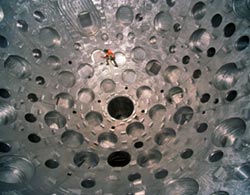
Interior of the NIF Target Chamber 
NOW: Inside the 118,000-kilogram target chamber of the National Ignition Facility. 

Completed in 2009, NIF is designed to generate 1.8 megajoules and 500 terawatts of ultraviolet laser energy, making Livermore once again home to the world's most powerful laser facility.Beginning in 1972, Livermore scientists designed, built and operated a series of increasingly energetic and powerful solid-state systems. It all started with the "4 pi" system and continued with Janus, Cyclops, the two-beam Argus, the 20-beam Shiva, the two beams of Novette, the 10-beam Nova, Petawatt and Beamlet (see "Empowering Light: Historic Accomplishments in Laser Research," Science & Technology Review, September 2002).
And now, the National Ignition Facility continues that tradition. Since the last of its 192 beams were installed in 2009, NIF offers unique capabilities, including the most energy of any laser facility in the world.
With its ability to provide a variety of laser pulse shapes and lengths, including the proposed ultrashort, petawatt (1015 watt) pulses, NIF also will offer more power than any other laser facility. NIF will be about 20 times more powerful than the Nova laser and will deliver about 60 times more energy. When Nova operated with ultraviolet light, it produced 30 kilojoules of energy and 25 terawatts of power. In contrast, the 192-beam NIF will generate 1.8 megajoules and 500 terawatts of ultraviolet laser energy.
LLNL technology has supplied the seed for other large glass laser efforts in the United States, including the Omega laser at the University of Rochester in New York and the Z-Beamlet laser now at Sandia National Laboratory in Albuquerque, NM. Lasers in Japan, France, the United Kingdom, Germany and other countries around the world also use LLNL-developed technology.

Source Related Posts with Thumbnails
Bookmark and Share

The National Ignition Facility: Ushering in a New Age for Science


Hot Hohlraum
“Every great advance in science has issued from a new audacity of imagination.”
—John Dewey
Scientists have been working to achieve self-sustaining nuclear fusion and energy gain in the laboratory for more than half a century. When the National Ignition Facility (NIF) begins ignition experiments at Lawrence Livermore National Laboratory (LLNL) in 2010, that long-sought goal will be much closer to realization.
NIF's 192 giant lasers, housed in a ten-story building the size of three football fields, will deliver at least 60 times more energy than any previous laser system. When all of its beams are fully operational, NIF will focus nearly two million joules of ultraviolet laser energy on a tiny target in the center of its target chamber – creating conditions similar to those that exist only in the cores of stars and giant planets and inside a nuclear weapon. The resulting fusion reaction will release many times more energy than the laser energy required to initiate the reaction.
Experiments conducted on NIF will make significant contributions to national and global security, could lead to practical fusion energy, and will help the nation maintain its leadership in basic science and technology. The project is a national collaboration among government, industry and academia and many industrial partners throughout the nation.
Programs in the NIF & Photon Science Directorate draw extensively on expertise from across LLNL, including the Physical and Life Sciences, Engineering, Computation and Weapons and Complex Integration directorates. This goal is a scientific Grand Challenge that only a national laboratory such as Lawrence Livermore can accomplish.

More Information

Much more information on the NIF & Photon Science Directorate's missions and programs is available on this Website. Here are some links to explore:
  • The Seven Wonders of NIF – How NIF scientists, engineers and technicians overcame a series of daunting technical challenges to bring NIF to the verge of success.
  • How NIF Works – What goes into creating the world's highest-energy laser system.
  • How to Make a Star – Achieving thermonuclear burn in the laboratory.
  • Stockpile Stewardship – Helping protect national security by ensuring that the nation's nuclear weapons are safe, secure and reliable.
  • Inertial Fusion Energy – Exploring new pathways to safe, clean, limitless energy.
  • Photon Science & Applications – Developing advanced high-power, high-intensity laser technology and applications.
  • Laboratory Astrophysics – Providing new tools to study the cosmos.
  • Plasma Physics – Understanding the behavior of turbulent plasmas, the "fourth state of matter."
  • People – Get to know some of the people who make NIF and Photon Science possible.
  • Education – Learn more about lasers and fusion energy.
Source Related Posts with Thumbnails
Bookmark and Share
Related Posts Plugin for WordPress, Blogger...

Statistic


View My Stats