Showing posts with label Mystery. Show all posts

Thursday, October 06, 2016

Proxima b 'may well' harbour life: New study claims 'second Earth' just four light years away has oceans and a thin gassy atmosphere


  • The planet, named Proxima b, orbits our closest star, Proxima Centauri
  • It is around 1.3 times the size of Earth 
  • New study simulated water on the planet
  • Concluded it 'very well host liquid water on its surface, and therefore also some forms of life' 
  • Hoped we could send a robotic explorer to the planet  

A team including CNRS astrophysicists have calculated the size and surface properties of the planet dubbed Proxima b, and concluded it may be an 'ocean planet' similar to Earth.
Scientists announced Proxima b's discovery in August, and said it may be the first exoplanet—planet outside our Solar System—to one day be visited by robots from Earth.
The planet orbits within a 'temperate' zone from its host star Proxima Centauri, some four light years from us.

Scroll down for video 
An artist's impression of a view of the surface of the planet Proxima b orbiting the red dwarf star Proxima Centauri, the closest star to the Solar System. A team including CNRS astrophysicists have calculated the size and surface properties of the planet dubbed Proxima b, and concluded it may be an 'ocean planet' similar to Earth.

It is estimated to have a mass about 1.3 times that of Earth, and orbits about 7.5 million kilometres (4.6 million miles) from its star—about a tenth the distance of innermost planet Mercury from the Sun.
'Contrary to what one might expect, such proximity does not necessarily mean that Proxima b's surface is too hot' for water to exist in liquid form, said a CNRS statement.
Proxima Centauri is smaller and 1,000 times weaker than our Sun, which means Proxima b is at exactly the right distance for conditions to be potentially habitable.

Proxima Centauri is smaller and 1,000 times weaker than our Sun, which means Proxima b is at exactly the right distance for conditions to be potentially habitable.

'The planet may very well host liquid water on its surface, and therefore also some forms of life,' the statement said.
In a study to be published in The Astrophysical Journal Letters, an international team led by researchers at the Marseille Astrophysics Laboratory (CNRS / Aix-Marseille Université) has determined its dimensions.
The size of exoplanets are generally calculated by measuring how much light they block out, from Earth's perspective, when they pass in front of their host star.
But no such transit of Proxima b has yet been observed, so the team had to rely on simulations to estimate the planet's composition and radius.
What Proxima b xould look like:  From left to right: Proxima b with the smallest attainable radius (65% metallic core surrounded by a rocky mantle separated into two phases), Earth (ditto with 32.5% core) and b with the Proxima maximum authorized range (50% of rocky mantle surrounded by a layer of water in solid and liquid form).
What Proxima b xould look like: From left to right: Proxima b with the smallest attainable radius (65% metallic core surrounded by a rocky mantle separated into two phases), Earth (ditto with 32.5% core) and b with the Proxima maximum authorized range (50% of rocky mantle surrounded by a layer of water in solid and liquid form).

They calculated the radius was between 0.94 and 1.4 times that of Earth, which is 6,371 kilometres on average.
Assuming a minimum radius of 5,990 km, the planet would be very dense, with a metallic core making up two-thirds of the entire planet's mass, surrounded by a rocky mantle.
If there is surface water, it would not contribute more than 0.05 percent to the planet's total mass, the team said—similar to Earth, where it is about 0.02 percent.
In the larger planet scenario, with a radius of 8,920 km, Proxima b's mass would be split 50-50 between a rocky centre and surrounding water.

WHAT MAKES PROXIMA B SO UNIQUE

Planet found in habitable zone around closest star to Earth
Loaded: 0%
Progress: 0%
0:00
Previous
Play
Skip
Mute
Current Time0:00
/
Duration Time3:27
Fullscreen
Need Text
Distance: This is the closest Earth-like planet we could ever find.
Orbiting our nearest star, the planet is only four light years away. 
Missions to send spacecraft to the planet to examine for signs of life are already in planning, and could happen within decades. 
Composition: The planet is rocky and a similar size to Earth.
Temperature: It lies in the 'habitable zone' of its star, which means there could be liquid water on its surface - a key ingredient for alien life. 
The temperature on the surface of the planet could be between -90° and 30° Celsius (-130 and 86 Fahrenheit).
Atmosphere: If Proxima b has an atmosphere, the simple ingredients - water, carbon dioxide, and rock - that are needed for the formation of biochemical cycles that we call life, could all be present and interacting on the planet's surface.
'In this case, Proxima b would be covered by a single, liquid ocean 200 km deep,' said the CNRS.
'In both cases, a thin, gassy atmosphere could surround the planet, like on Earth, rendering Proxima b potentially habitable,' it concluded.
Earlier this year, a group of researchers, using the European Southern Observatory (ESO) telescopes, have named the exciting world Proxima b.
Thousands of exoplanets have been discovered before, but unlike the others, this planet is within our reach. 
While four light years is a long way - more than 25 trillion miles - future generations of super-fast space craft could conceivably travel to the planet within the next few decades. 
If there is surface water, it would not contribute more than 0.05 percent to the planet's total mass, the team said—similar to Earth, where it is about 0.02 percent.

A comparison  of several exoplanets. Curves correspond to specific compositions used in the model of internal structure. The existing area of Proxima b is drawn in gray and takes into account the uncertainty of its mass and its different possible compositions.
A comparison of several exoplanets. Curves correspond to specific compositions used in the model of internal structure. The existing area of Proxima b is drawn in gray and takes into account the uncertainty of its mass and its different possible compositions.
Much further in the future the planet may even be colonised by space travellers from Earth.
One possible obstacle to life evolving and flourishing on the planet is the way it hugs its parent star. 
Proxima b is only 4.6 million miles (7.5 million km) from the star, 5 per cent of the distance between the Earth and the sun, and takes just 11.2 days to complete one orbit. It is around 1.3 times as massive as Earth.
But because Proxima Centauri is a dim red dwarf star radiating much less heat than the sun, it still occupies the 'habitable zone' where temperatures are mild enough to permit liquid surface water.
The temperature on the surface of the planet could be between -90° and 30° Celsius (-130 and 86 Fahrenheit). 

On the other hand, the planet is blasted by powerful ultraviolet rays and X-rays from the star. Any life that evolved on its surface would have to be hardened against the radiation.
But the prospect of finding life on Proxima b has excited scientists.
'Many exoplanets have been found and many more will be found, but searching for the closest potential Earth-analogue and succeeding has been the experience of a lifetime for all of us,' Dr Guillem Anglada-Escudé, lead author of the paper, said.
'Many people's stories and efforts have converged on this discovery. The result is also a tribute to all of them. The search for life on Proxima b comes next.' 
'Proxima B is our neighbour': New Earth-like planet discovered
Loaded: 0%
Progress: 0%
0:00
Previous
Play
Skip
Mute
Current Time0:00
/
Duration Time1:16
Fullscreen
Need Text
Two separate papers were published , describing the habitability of Proxima b and its climate.
The papers find the existence of liquid water on the planet today 'cannot be ruled out'.
This means water may be present over the surface of the planet. But it would only be in the sunniest regions, either in an area in the hemisphere of the planet facing the star.
The way Proxima b rotates, strong radiation from its star and the formation history of the planet makes its climate quite different from that of the Earth. 
It is unlikely that Proxima b has seasons. But if liquid water does exist on the planet, it could mean alien life might thrive there.
If this is the case, we could discover it within decades, experts have said. 
Artist's impression of an Earth-like exoplanet. The still nameless planet is believed to be Earth-like and orbits at a distance to Proxima Centauri that could allow it to have liquid water on its surface - an important requirement for the emergence of life

PROXIMA CENTAURI 

Just over four light-years from the solar system lies a red dwarf star.
Because it is the sun's closest neighbour, the star has been named Proxima Centauri.
This cool star in the constellation of Centaurus is too faint to be seen with the unaided eye and lies near to the much brighter pair of stars known as Alpha Centauri AB.
A team called Pale Red Dot is behind the discovery, which includes researchers from the University of Hertfordshire, Queen Mary University of London, the Instituto de Astrofísica de Andalucía in Granada, Spain and the University of Göttingen in Germany, among others. 
The researchers used the High Accuracy Radial velocity Planet Searcher (HARPS), an instrument on the European Southern Observatory's 3.6-metre La Silla telescope in Chile's Atacama Desert.
The telescope measured light from Proxima, the fingerprints that reveal what the star is made of.
Small shifts in the frequency of the starlight can be used to work out tiny movements of the star in response to an orbiting planet's gravitational pull.

OTHER 'SECOND EARTHS' THAT HAVE BEEN FOUND ACROSS THE UNIVERSE 

Nasa's Kepler telescope has also been busy in the hunt for alien life, finding over 4,000 new planets outside our solar system over the past three years.
Earlier this month a team of astronomers has narrowed down this list to those with the most potential to have liquid water, or even life.
They pinpointed 20 out of the 4,000 that are most likely to be like our own, and are starting to look more closely at these candidates.
These 'second Earths' are much further away than Proxima b, so are harder to explore.
216 Kepler planets are located within the 'habitable zone' - an area around a star in which an orbiting planet's surface could hold liquid water.
Of those, they list 20 that are the best candidates to be habitable rocky planets like Earth.
The list includes Kepler-186 f, Kepler-62 f, Kepler-283 c and Kepler-296 f.
'The first hints of a possible planet were spotted back in 2013, but the detection was not convincing,' said Dr Anglada-Escudé.
'Since then we have worked hard to get further observations off the ground with help from ESO and others. The recent Pale Red Dot campaign has been about two years in the planning.'
The Pale Red Dot data, when combined with earlier observations made at ESO observatories and elsewhere, revealed the clear signal of an exciting result.
At times Proxima Centauri is approaching Earth at about 3 miles (5km) per hour and at times it is receding at the same speed.
This pattern of changing velocities repeats with a period of 11.2 days, meaning that is how long it takes to orbit its sun.
The orbit of the planet around Proxima Centauri (Proxima b) with the same region of the Solar System.

Careful analysis of the tiny light shifts showed the planet has a mass at least 1.3 times that of the Earth, orbiting about 4.3 million miles (7 million kilometres) from Proxima Centauri.
Some questions about whether life could exist are left unanswered, however.
'If Proxima b has an atmosphere and if there is water there, and these are big 'ifs', it is intriguing to think that the simple ingredients - water, carbon dioxide, and rock - that are needed for the formation of biochemical cycles that we call life, could all be present and interacting on the planet's surface,' said Dr Mikko Tuomi, from the Centre for Astrophysical Research at the University of Hertfordshire.

COULD WE TRAVEL TO THE PLANET?

The true test would be to go there. Using conventional space technology (either manned or unmanned) and some clever slingshot manoeuvres, it would take at least 15,000 years to reach Proxima Centauri.
But the ambitious Starshot Project aims to send tiny robots to this star system, propelled by powerful Earth-based lasers.
They are estimating that it would only take about 20 years to get there in this manner, travelling at a speed of approximately 60,000 km per second (or 135m miles per hour).
Those robots could relay back data about the system, and potentially even close-up pictures of Proxima b.
Source: Martin Archer, Space Plasma Physicist, Queen Mary University of London, writing for The Conversation.
'But we do not really know. We need to study this system a lot more over the coming decades in order to be able to start answering such questions. 
'However, it is a great place to start looking for life outside the solar system and it is a very exciting discovery.' 
'It certainly seems possible that we could find something out of this world within our lifetime,' said Martin Archer, Space Plasma Physicist, Queen Mary University of London, writing for The Conversation.
At least some additional information about the environmental conditions on Proxima Centauri b should come sooner rather than later, the researchers say.
Now that the planet has been detected, there is an opportunity for follow-up observations.
A possible detection of life, or at least of conditions suggestive of the presence of life, is likely to be decades off
But these observations provide opportunities to learn about a planet around the most common type of star in our galaxy – with lessons that are interesting in their own right, for astronomers seeking a systematic understanding of planet formation in our home galaxy.  


Wednesday, January 04, 2012

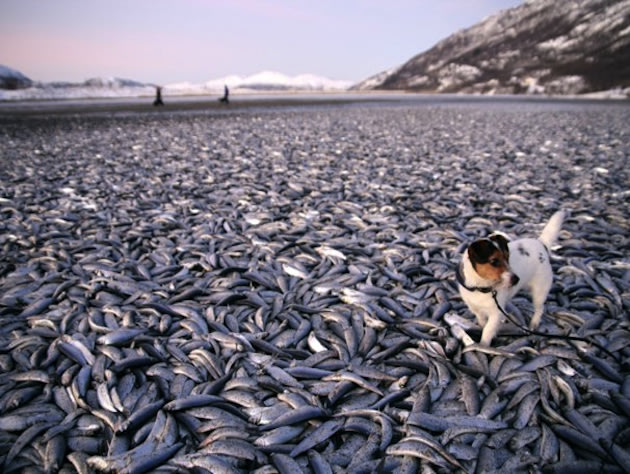
20 tons of herring wash up on Norway coast


Molly the dog discovers 20 tons of herring on a Norwegian beach

The fish remains turned up on Norway's northern coast on New Year's Eve, and officials are still looking to explain just how and why they showed up.

World-first hybrid shark found off Australia


Scientists said on Tuesday that they had discovered the world's first hybrid sharks in Australian waters, a potential sign the predators were adapting to cope with climate change.
The mating of the local Australian black-tip shark with its global counterpart, the common black-tip, was an unprecedented discovery with implications for the entire shark world, said lead researcher Jess Morgan.

Saturday, May 07, 2011

Secrets of the Star Disc


When grave robbers ransacked a Bronze Age burial in Germany, they had no idea that they had unearthed the find of a lifetime.
The disc they found combines an advanced understanding of the stars with some of the most sophisticated religious imagery of the age.
In intellectual achievement and also age, it surpasses anything yet found in Egypt or Greece. It seems that civilization had already dawned in North Central Europe.
The Nebra Sky Disc is a bronze disc inlaid with gold symbols, associatively dated to c. 1600 BCE. The symbols are interpreted generally as a sun or full moon, a lunar crescent, and stars (including a cluster interpreted as the Pleiades).
Two golden arcs along the sides, marking the angle between the solstices, were added later. A final addition was another arc at the bottom surrounded with multiple strokes (of uncertain meaning, variously interpreted as a Solar ship with numerous oars or as the Milky Way).
The disc is unlike any known artistic style from the period, and had initially been suspected of being a forgery, but is now widely accepted as authentic.
The creators of the disc have been associated with the Bronze Age Unetice culture. Their physical type, which matches that of the preceding Corded Ware people, is still commonly found in North Central Europe today.
Hydrodynamic patterns in the culture area suggest that these people were speakers of Indo-European, with pre-Germanic dialects in the area to the north of the Ore Mountains, including the site of discovery.
Source

Related Posts with Thumbnails

Saturday, March 05, 2011

Interview with Abductee Becky Andreasson

Becky Andreasson is the daughter of famous abductee, Betty Andreasson Luca, and an abductee herself. She has now launched her own web site, where she shares her life long experiences with beings not of this world. She has been kind enough to answer some questions from B J about the strange, paranormal encounters which have touched the lives of her and her family.
Five books, to date, have been authored about these ongoing events, plus many newspaper articles, magazines, and web articles. Becky says that what has influenced her more than anything else is the mystical language taught to her by the "Elders."
Her experiences began as a young child, when she was taken from her crib by one of the Elders. When she was returned, she was left outside of her house. Her mother was informed by the next door neighbor that Becky was playing outside. There was no way she could have left the house by herself. Her mother was frightened by this puzzling occurrence... but the full implication of these happenings would only be revealed many years later. See the about.com case file on the the Betty Andreasson Abduction
  
B J: Becky, thank you for taking the time to answer some questions for our readers. I am sure this will give them a better understanding of the enigmatic experiences of alien abductees.
Becky: You're very welcome B J
B J: On your web site, you talk about the time you were taken from your crib as a child. Was this your family's first paranormal experience?
Becky: No this was not my family's first paranormal experience. I was a new born infant in my bassinet, next to my parents bed. Around 3:00 AM my mother was awakened by a man's gentle voice calling her name. She looked at me and glanced around the room, her name being called again, she could see no one. Try as she may, my father would not wake up, so through fear, she quickly covered her head with the blanket! This was my beginning, linked to my mothers line of on going paranormal experiences.
B J: Do you recall any details about the alien craft you were taken to? What did the aliens look like?
Becky: There were several occasions when I was in alien crafts and yes I do recall. First there was soft lighting with no casting of shadow in all the crafts I've been in. I heard what sounded like glass wind chimes in the crafts. There were training stations, large screens, unusual toys, tall, glass-like cylinders, floating disks, rooms of mirrors, seats, tables,types of windows in some of the rooms, a large open canister that contained the same light that held me up in my bedroom, from that growling creature crouched in the corner of my room. There was also some of the symbolic symbols written above a door in one of the rooms. These are a few details of crafts I've been in.
My experiences are with a few different types of aliens; The Elders/Human looking, tall, white hair, blue eyes, very light white skin and dressed in white garments.
The Beings/Human looking, a bit shorter then the Elders, light blond hair, green eyes, white skin and dressed in white garments; these Beings, in my opinion, look like they could pass as human!
Ishta/Human looking, seemed tall to me, reddish-brown hair, brown eyes, white skin, dressed in a dark green garment and wore a mystical ring on her finger!
E sa/ Human looking, very tall, whitish-gray hair,olive-green skin, dressed all in white and when he spoke, it was in a singing form in the language of the symbols I was taught and I understood him! E sa wore a jeweled medallion necklace.
The Grays/short-around 3 to 4 1/2 feet tall, large, dark almond shape eyes, slit for mouth,indented-nose and ears, large head, no hair, grey skin.
Creature in the corner of my bedroom; dark murky brownish color, red eyes, growling!kind of looks like a chupacabra creature.
There are other beings I have encountered and paranormal experiences that I have had. These will be revealed on my web site in the near future!
B J: Do you recall having any interaction with the other two children who were playing with the weightless toys? Did they notice you when you came in?
Becky: Yes. We all played with the toys together and when Nadine and I were sitting in the seat, I whispered to her, "Don't be afraid," as she was squeezing my hand. Her and I also played at the big screen.
B J: How many other encounters did you have before the famous 1967 abduction of your mother?
Becky: Several, some are recorded in the Andreasson Legacy.
B J: Do you remember the suspended animation while it was happening, or was it only afterward that you were aware of it?
Becky: No, I don't remember being in suspended animation, I do remember being active and seeing other family members in the suspended state.

B J: You call the aliens "peculiar" looking. Can you describe them for us?
Becky: At age 11, they looked like clay men in suits with big heads and large eyes, to me.
B J: Did they communicate with you or other members of your family? If so, how?
Becky: In the 1967 encounter, they communicated telepathically with Mom and I, also Jessup played light games in the air with me.
B J: You call the aliens, "The Watchers." What is the origin of this term, as relating to the aliens?
Becky: "The Watchers," this term relating to the aliens for me means that these Watchers are doing just that, watching over Mankind.
B J: Can you say that these beings were the same as those who took you as a child?
Becky: From birth to age 12, I was taken by the Elders, Beings and Ishta. After 12 years old, there were Elders, Beings, Ishta, and GRAYS. Also something people do not know about my experience in 1967, this was the VERY FIRST TIME I EVER SAW A GRAY! Mom was taken and the family all stayed in suspended animation, and I was playing light games in the air with Jessup!
B J: Were you told to call one of the Watchers, Jessup? Did he introduce himself to you with that name, or did you just know that?
Becky: No, I was not told to call him Jessup. No, he didn't introduce himself, I just knew that he is Jessup.
B J: The "blue book" that you mentioned as the beginning of your knowledge of symbolic writing, what happened to it?
Becky: I don't know what happened to it.
B J: When you were taken from your Virginia home, you mention being trained at different stations. What are the stations, and where were they located?
Becky: There were three stations in a funny shaped room all open. 1st station was a screen with the symbols, the 2nd was a station that furthered my activation and interaction of the symbolic training, and the 3rd was measuring and sealing the symbolic training within me.
B J: You mention the skin peeling from your hand after the training. Did you ever seek medical help for this?
Becky: No, I couldn't afford the medical bill at the time. It was like a sun burn peel, and it did not hurt at all; there was no pain. I didn't worry about it. It was all peeled off and healed within within two weeks time.
B J: You claim to have a certain "connection" with symbolic writing. Are you psychic, and do you have any other special abilities?
Becky: Yes, I'm am connected to the Symbolic Writing, by a form of drawing and a special channeling from a lifetime connection with the Elders and the blessed learning of this wonderful ancient symbolic language. These writings I do for people connect them to the Elders, each writing is all about Only that Person and Their Life.
Yes, I am psychic and some of my other special abilities are I'm artistic, I write poetry, which has been published, and I sometimes I am able to discern dreams. I do have a few other special abilities, but for now I'll keep those hush, hush!
B J: You come from a large family. Have any of your brothers or sisters had experiences like yours, beside your mother and stepfather?
Becky: Yes, but I would prefer not to comment on my family as to respect their privacy.
B J: How is your relationship with other members of your family? Are you a close family?
Becky: Wonderful, we are a close knit family.
B J: There is some great art work on your site, drawn by your mother. Are these from experiences of yours that you related to her?
Becky: Thank You B J. Yes, they are drawn by my mom and they are of my experiences I have related to her.
B J: Are the experiences still ongoing for your mother and stepfather?
Becky: Yes, but again I feel they should speak of this, not I.
B J: Do you socialize with other alien abductees, or belong to any kind of support group?
Becky: Besides my family, no, I do not belong to any support groups.
B J: Were you or any members of your family subjected to regressive hypnosis?
Becky: Yes, I was and some family members were, but portions of our experiences were consciously remembered as well.
B J: You mention several different types of alien beings on your site. One of them was more like a creature that was in your bedroom. How would you describe this being?
Becky: I was surprised to later see a close resemblance to the chupacabra and thankfully I was protected in the beam of light!
B J: Tell us what you think about Ufology today. Are we making any progress in solving or understanding the mysteries behind UFOs and alien abduction?
Becky: I do not have much information on the whole of Ufology, of what I do know, great strides have been made by video cams and brave people coming forward seems more so today then yesteryears. Also though we are still fighting against disinformation, cover-ups, intimidation, and fear, which I hope some day we will be free of! All in all, I feel we are making positive progress, LEARNING and UNDERSTANDING, YES!
B J: Thank you so much for the time you have spent with me. Do you have any additional comments you would like to relate to our readers?
Becky: Yes, thank you, B J. There will be more added to my web site in the near future on my past and on going experiences. Showers of Blessings to All!
Source

Related Posts with Thumbnails
Related Posts Plugin for WordPress, Blogger...

Statistic


View My Stats