Sunday, January 10, 2010

Super-Earth: Astronomers Find a Watery New Planet


An international has spotted a new planet 2.7 times bigger than Earth, circling a dim red star called GJ 1214, just 40 light-years away in the constellation Ophiuchus


Back in the mid-1990s, when astronomers were just beginning to find new planets around distant stars, nearly every new discovery got front-page headlines. Today, with the extrasolar-planet count up to about 400, it takes something extraordinary to make news.

See the best pictures of 2009.
But extraordinary may be too understated a descriptor for the discovery reported on Wednesday in the journal Nature: an international team led by Harvard astronomer David Charbonneau has spotted a "super-Earth," a planet 2.7 times bigger than Earth, circling a dim red star called GJ 1214, just 40 light-years away in the constellation Ophiuchus. "It's spectacular," says Geoffrey Marcy of the University of California, Berkeley, who is the world's most prolific planet hunter and is credited with discovering 70 of the first 100 exoplanets. "It's a top-of-the-top discovery in the quest for Earth-size planets." (See the top 50 space moments since Sputnik.)

While the new planet, dubbed GJ 1214b, is too big to be considered Earth-like, it comes pretty close. But GJ 1214b's relatively compact size — smaller than the vast majority of planets identified so far — is only one reason for astronomers' enthusiasm. Another is GJ 1214b's likelihood of bearing the stuff of life: water.

If you're looking for a world where life might thrive, a planet must be at the right temperature for water to exist in liquid form. So it needs to orbit its star in the so-called habitable zone, a "Goldilocks" location that allows a planet to be neither too hot nor too cold. In that respect, GJ 1214b is again a near miss. Its surface temperature hovers at a sweltering 190°C (374°F), which is well above the boiling point of water, at least in Earth's atmospheric pressure. Fortunately, GJ 1214b's atmosphere makes the pressure a lot higher than on Earth — "crushing," as Charbonneau describes it — and increases the odds of liquid water. (Under pressure, water can remain liquid above 100°C, or 212°F.)

Astronomers were further able to estimate the planet's makeup by calculating its size, based on the amount of light that GJ 1214b blocked when it passed in front of its star, as well as its mass (6.6 times Earth's mass), based on the wobble in the wavelength of starlight caused by GJ 1214b's gravitational pull on its star. That analysis revealed the new planet's density: about one-third of Earth's. Because water has a much lower density than rock, astronomers figured that the "most plausible scenario is a planet made mostly of water, with a significant atmosphere," says Charbonneau. So despite its high temperature, GJ 1214b's high atmospheric pressure and relatively low density mean liquid water could exist there after all.

Nevertheless, it's too soon to suggest that astronomers have found the site of potential exoplanetary life. "What you want [for life] is a nice toasty ocean with a little bit of atmosphere. That's not going to happen here," says Charbonneau. "I think it would be foolish to say categorically that [GJ 1214b] doesn't have life. But we have no basis for thinking it could."

If it does, astronomers will be able to look for it in unprecedented detail. Since GJ 1214b is only 40 light-years away, which is practically next door in cosmic terms, its atmosphere can be studied more closely than that of any other exoplanet, both with the Hubble Telescope and with the infrared-sensitive Spitzer Space Telescope. Charbonneau's team has already applied for observing time on both scopes to do just that.

Perhaps the most exciting thing about the discovery of GJ 1214b is that the planet was found at all. Planet hunters usually focus their attention on Sun-like stars — that is, large and hot — on the assumption that if you're looking for life, you should look in a place that is as similar to our solar system as possible. Charbonneau, however, focused on about 2,000 small, dim, red stars known as M-dwarfs, nearby Earth. M-dwarfs are much more numerous than Sun-like stars; of the 300 stars closest to Earth, says Charbonneau, 220 or so are M-dwarfs. They're also much cooler than Sun-like stars, so their habitable zones are close-in. A planet in the Goldilocks position around an M-dwarf doesn't take a year to orbit, as Earth does; it takes only a few days (1.6 days, in the case of GJ 1214b). So astronomers need to wait only a few days to spot a planet passing by, and only a few weeks to confirm the orbit with several passes. (See pictures of different nations' space programs.)

M-dwarfs are so small, moreover, that an Earth-size planet casts a relatively big silhouette as it passes in front of it, making the telltale dimming of starlight easy to spot. It's so easy, in fact, that Charbonneau didn't even need a giant telescope to see it. Instead, he got away with the kind of scope a serious backyard amateur might use. In other words, says Charbonneau, "we did it on the cheap."

They also did it fast. "We thought it would take us two years to find something like GJ 1214b," says Charbonneau. "It took just six months. Either we got really lucky, or these planets are common." If they are, then it wouldn't be surprising for astronomers to find planets that are slightly smaller and slightly cooler — in short, more Earth-like — as well.

Charbonneau's group isn't the only one looking. An international consortium of observatories just announced the discovery of several other super-Earths around Sun-like stars, though these new planets are far too hot to sustain life and too far away to be able to study. Separately, NASA's Kepler Mission will present the first results of its planet search at the American Astronomical Society meeting in Washington in January. "[The Kepler team] has already submitted 28 scientific papers based on 43 days of data or less," says MIT planet theorist Sara Seager. "It's going to be a big year for planets."

Source
Related Posts with Thumbnails
Bookmark and Share

Russia's Armageddon plan to save Earth from collision with asteroid

Asteroid strike
Computer generated simulation of an asteroid strike on the earth 150m years ago.
Photograph: Don Davis/AFP/Getty Images


Space scientists in Russia are preparing to boldly go where no man has gone before, except for the actor Bruce Willis.
The head of the Russian space agency said today that it was considering a Hollywood-style mission to send a spacecraft to bump a large asteroid from a possible collision course with Earth.
Anatoly Perminov told the Russian radio station Golos Rossii: "People's lives are at stake. We should pay several hundred million dollars and build a system that would allow us to prevent a collision, rather than sit and wait for it to happen and kill hundreds of thousands of people."
The mission would be aimed at an asteroid called Apophis, he said, which is expected to pass close to the Earth in 2029 and again in 2036. "Calculations show that it's possible to create a special-purpose spacecraft within the time we have, which would help avoid the collision. The threat of collision can be averted."
The Hollywood action films Deep Impact and Armageddon both featured space missions scrambling to avert catastrophic collisions, the latter led by Willis.
But the creation of a system to deflect asteroids has long been the subject of scientific debate. Some experts have proposed sending a probe to circle around a dangerous asteroid and gradually change its trajectory. Others suggested sending a spacecraft to collide with it and alter its momentum, or using nuclear weapons.
Perminov said details of the project still needed to be worked out. But he said the agency would invite Nasa, the European Space Agency and others to participate.
When Apophis was discovered in 2004, astronomers made headlines when they said there was a one in 37 chance that the 350-metre-wide rock would collide with Earth in 2029. Further studies ruled out such an impact, but there remains a one in 250,000 chance it could strike in 2036.
Perminov said he had heard from a scientist that Apophis is getting closer and may hit the planet. "I don't remember exactly, but it seems to me it could hit the Earth by 2032," he said.
Nasa has estimated that if the asteroid hit the Earth, it would release more than 100,000 times the energy released in the nuclear blast over Hiroshima. Thousands of square miles would be directly affected by the blast but the whole of the Earth would see the effects of the dust released into the atmosphere.
Nasa experts have already discussed the option of landing an astronaut on an asteroid to test whether it could develop techniques to deflect a doomsday rock.
Breaking it up with an atomic warhead could generate thousands of smaller objects on a similar course, which could have time to re-form. Scientists agree the best approach, given enough time, would be to nudge the object into a safer orbit.
Matt Genge, a space researcher at Imperial College London, has calculated that something with the mass, acceleration and thrust of a small car could push an asteroid weighing a billion tonnes out of the path of Earth in just 75 days.
Perminov said: "We will soon hold a closed meeting of our collegium, the science-technical council, to look at what can be done. "There won't be any nuclear explosions. Everything will be done according to the laws of physics."
Mirrors, lights and even paint could change the way the object absorbed light and heat enough to shift its direction over 20 years or so. With less notice, mankind could be forced to take more drastic measures, such as setting off a massive explosion on or near the object to change its course.

Source
Related Posts with Thumbnails
Bookmark and Share

Skiff Reader to Be Featured in CES 2010

Skiff Reader

As the upcoming in Las Vegas is expected to have a plethora of e-book readers on display, one product that has been gaining attention before its official launch is the Skiff Reader, which claims to be the first of its kind that is optimized for newspaper and magazine content.
The Skiff Reader measures 0.25 inches in thickness, weighs a bit over one pound, and has a large 11.5-inch e-paper display with 1200 x 1600 pixels resolution and intuitive touchscreen navigation.  That's about two inches bigger than Amazon's Kindle DX, not to mention it has a very thin bezel.  Additionally, its e-paper display is the first to be based on a flexible sheet of stainless-steel foil from LG Display instead of traditional glass that is fragile and easy-to-break.
This ebook reader will be connected to Sprint via 3G, although it can also support wireless connectivity through WiFi.  Sprint will also sell the Skiff Reader within the 2010 in its authorized retail locations and on sprint.com.  Pricing, as well as the publications available, will be announced at a later date.
Image source:  Skiff
Source
Related Posts with Thumbnails
Bookmark and Share

Saturday, January 09, 2010

Inside the Mars-500 'spaceship'

Russia's ambitious plan to put a group of prospective cosmonauts in isolation for 17 months, as a potential first step of a mission to Mars, will start in a year's time.
Richard Hollingham of BBC World Service's Discovery programme gained rare access to the Mars-500 project's home at the Institute of Biomedical Problems in Moscow, to take a look at the preparations under way there.


Richard Hollingham tests an exercise suit
Special exercise pulleys will prevent muscle wastage in space

Early next year, six Russian cosmonauts will climb through the hatch of the Mars-500 "spaceship" and not come out for over 500 days.
The mock-up of a Martian craft is the first part of an ambitious project to send humans to Mars.
"The Mars-500 project is envisaged as an answer to the big question of whether a human being can realise a Martian flight - taking into account all the limitations and restrictions which are characteristic of this flight," says deputy director of the institute, Dr Viktor Baranov, who has overall responsibility for the Mars 500 experiment.
"We need to understand that in a manned flight, the people are the most vulnerable thing."

Napkin shower
The institute is very busy. Because not all aspects of the Mars mission can be simulated in the ground-based Mars-500 project, other experiments are being conducted in parallel.
Obviously, once any real mission to Mars got under way, a crew member could not simply leave when they felt like it - so Mars-500 will involve numerous studies of autonomy and isolation.


Students at the Institute of Biomedical Problems
Scientists will constantly monitor the health of the 'cosmonauts'
The scientists will also be watching the crew's psychological response to being confined, in order to watch for conflicts.
And they will study the effectiveness of telemedicine, as there will be no hospital on the ship.
The Mars-500 mock-up features the cramped personal quarters that would be an inevitable part of a real craft. Each cosmonaut has a narrow bed, some small shelves, a desk and a wardrobe.
There is no shower - instead, the cosmonauts clean themselves in a heat chamber like a sauna, and use napkins to scrape off the dirt.
Scientists here are keen to stress, however, that the Mars-500 craft is not a prison and that if a crew member wants to leave they can do so.
It also may be the case that doctors recommend a person leaves based on their medical data, or if the state of the facility drops to a level where it is affecting health and safety.
However, ultimately the institute does want people who can last the full 500 days - which means it takes a special kind of person to volunteer.
They are looking for highly-motivated people to form a team which will include a physician, a biologist, an IT specialist and engineer.

'One organism, one body'
Sergei Ryazansky is a young cosmonaut who works at the Institute of Biomedical Problems. He has not yet been into space, but has been in the simulation - and would like to be one of the first to put his name forward for a real mission to Mars.
"Training of crew members - especially their personal and psychological training - must be at a really high level," he said.


Prime Minister Viktor Zubkov and the head of the Federal Space Agency, Anatoly Perminov listen to a presentation
The government wants to be on the safe side; it wants to know what technologies we have

Anatoly Grigoriev, director of the Institute of Biomedical Problems
"In the Autumn we had a technical crew that I commanded for two weeks. We were testing all the equipment of the module. One day I saw one guy not acting like usual. He was missing his girlfriend.
"It is really important to see such things and help; to give him work to keep him busy. The only way to survive such an extreme flight will be working as one organism, one body; helping each other, discussing everything."
To make the training exercise more realistic, the designers have brought in a time delay.
Because it can take around 20 minutes for a message to travel from Mars to Earth, it takes this amount of time in the simulation.
This means there can be no real-time conversations with friends and family - and that, in moments of crisis, the crew will have to make crucial decisions themselves.
Meanwhile, the cosmonauts will also have to deal with the impact of prolonged weightlessness on the human body.
Inesa Koslovska from the department of Sensory, Motor and Physiology and Countermeasures has been tracking what happens when people spend long periods away from gravity.
"Muscles immediately start to deteriorate" she says.
This is followed by changes in cardio-vascular function and all metabolic processes, she says.
"Then our bones start to deteriorate, because they get their signals from the muscles," she adds.
In space all of this would not matter - but as soon as the cosmonauts returned to Earth, they would be so weak they would not be able to stand.

First step
Dr Koslovska found that the main trigger for these changes is muscular unloading, so she developed a number of counter-measure exercises to allow the cosmonauts to keep muscle tone in space.
The most important is a specially-developed treadmill, on which a suit is attached via elastic pulleys. Instead of gravity, the runner has to strain against the tension of the pulleys.

Russian Proton-M rocket blasts into space at Kazakhstan's Baikonur cosmodrome
Russia has continued space launches from bases in Kazakhstan
"We don't have weight in space - but in this suit, you do," Dr Koslovska says.
Of course, Mars-500 remains only the first step - the decision to commit so much time and energy to a Mars mission has not been explicitly backed by the Kremlin.
But as Anatoly Grigoriev - director of the Institute of Biomedical Problems - points out, neither has it been discouraged.
"The government wants to be on the safe side; it wants to know what technologies we have," he says.
"When these factors are gathered, it will be easier to convince taxpayers at large that there is a possibility of success for such a mission.
"The time has come now when the knowledge has been gathered. The mission can be undertaken with a possibility of success."
Source
Related Posts with Thumbnails
Bookmark and Share

Friday, January 01, 2010

Christmas tree


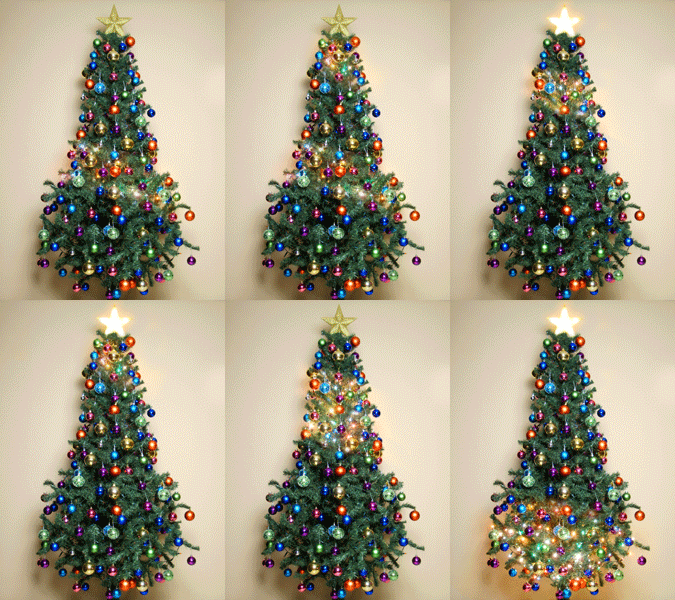
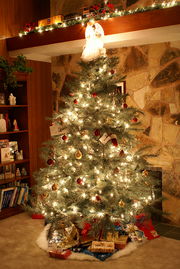
The Christmas tree is a decorated evergreen coniferous tree, real or artificial, and a tradition associated with the celebration of Christmas or the original name Yule. The Christmas tree is often brought into a home, but can also be used in the open, and can be decorated with Christmas lights (originally candles), ornaments, garlands and tinsel during the days around Christmas. An angel or star is often placed at the top of the tree, representing the host of angels or the Star of Bethlehem from the Nativity.


History
The ancient pagans, Druids, Egyptians, and Chinese, celebrated the Winter Solstice, (Dec. 21st), the day of the year that the Sun begins its ascent in the sky, thereby ushering a fertile time of planting and bountiful harvests. Hence, the evergreen tree represented eternal life and the promise of replenishment during the cold winter months[citation needed]. Apples and other fruit were hung upon the tree to represent the plentiful food to come. Candles were lighted to symbolize the warmth and brightness of the sun. While the Christmas tree is generally associated with Christ, it predates this religious figure by many centuries.

Later in history Germans hung wafers on the tree along with the apples to represent the sacrifice of Jesus on the cross. In the Victorian era, the apples were replaced by red glass balls and candles and the representation signified both Adam and Eve along with the fire of life. Moreover, the Christmas tree was also used to scare away evil forces for the new year.

After the beginning of the New Year, January 1, the Pagans would take the chopped decorated Christmas tree down and burn the "Yule" log in remembrance of the past year. They would rejoice in song and dance for the goals that have been completed and in jubilation for the coming of the Spring and life. Furthermore, New Year's resolutions were constructed at a later date from the Pagans setting of the goals.

Origin
According to Christian lore, the Christmas tree is associated with St Boniface and the German town of Geismar. Sometime in St Boniface's lifetime (c. 672-754) he cut down the tree of Thor in order to disprove the legitimacy of the Norse gods to the local German tribe. St. Boniface saw a fir tree growing in the roots of the old oak. Taking this as a sign of the Christian faith, he said "...let Christ be at the center of your households..." using the fir tree as a symbol of Christianity.


An artificial Christmas tree inside a home.


The custom of erecting a Christmas Tree can be historically traced to 16th century Northern Germany and the Baltic region, though neither an inventor nor a single town can be identified as the sole origin for the tradition. According to the first documented uses of a Christmas tree in Estonia, in 1441, 1442, and 1514 the Blackheads erected a tree for the holidays in their brotherhood house in Tallinn. At the last night of the celebrations leading up to the holidays, the tree was taken to the Town Hall Square where the members of the brotherhood danced around it. In 1584, the Estonian chronicler Balthasar Russow wrote of an established tradition of setting up a decorated spruce at the market square where the young men “went with a flock of maidens and women, first sang and danced there and then set the tree aflame”.

The first documented use of an evergreen tree in a Christmas celebration is from Riga, Latvia, in the year 1510. The legend says that the first Riga tree was decorated with paper flowers and burnt on the bonfire after the ceremony. In that period, the guilds started erecting Christmas trees in front of their guildhalls: Ingeborg Weber-Kellermann (Marburg professor of European ethnology) found a Bremen guild chronicle of 1570 which reports how a small tree was decorated with "apples, nuts, dates, pretzels and paper flowers" and erected in the guild-house, for the benefit of the guild members' children, who collected the dainties on Christmas Day. Another early reference is from Basel, where the tailor apprentices carried around town a tree decorated with apples and cheese in 1597.

18th and 19th century
By the early 18th century, the custom had become common in towns of the upper Rhineland, but it had not yet spread to rural areas. Wax candles are attested from the late 18th century. The Christmas tree remained confined to the upper Rhineland for a relatively long time. It was regarded as a Protestant custom by the Roman Catholic majority along the lower Rhine and was spread there only by Prussian officials who were moved there in the wake of the Congress of Vienna in 1815. Just like Christmas (Germanic Yuletide), the Christmas tree was more or less accepted by the Roman Catholic Church because it could not prevent its use.

The tradition was introduced to Canada in the winter of 1781 by Brunswick soldiers stationed in the Province of Quebec to garrison the colony against American attack. General Friedrich Adolf Riedesel and his wife, the Baroness von Riedesel, held a Christmas party at Sorel, delighting their guests with a fir tree decorated with candles and fruits.

In the early 19th century, the custom became popular among the nobility and spread to royal courts as far as Russia. Princess Henrietta of Nassau-Weilburg introduced the Christmas tree to Vienna in 1816, and the custom spread across Austria in the following years. In France, the first Christmas tree was introduced in 1840 by the duchesse d'Orléans.


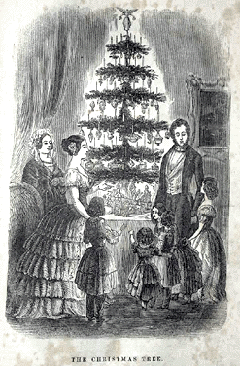
The Queen's Christmas tree at Windsor Castle, 1848. Republished in Godey's Lady's Book, Philadelphia December, 1850. Victoria's crown, Prince Albert's mustache edited.


In Britain, the Christmas tree was introduced in the time of the personal union with Hanover, by George III's Queen Charlotte of Mecklenburg-Strelitz in early 1800s, but the custom hadn't yet spread much beyond the royal family. Queen Victoria as a child was familiar with the custom. In her journal for Christmas Eve 1832, the delighted 13-year-old princess wrote, "After dinner...we then went into the drawing-room near the dining-room...There were two large round tables on which were placed two trees hung with lights and sugar ornaments. All the presents being placed round the trees..". After her marriage to her German cousin Prince Albert, by 1841 the custom became even more widespread throughout Britain. In 1847, Prince Albert wrote: "I must now seek in the children an echo of what Ernest [his brother] and I were in the old time, of what we felt and thought; and their delight in the Christmas-trees is not less than ours used to be".

A woodcut of the British Royal family with their Christmas tree at Windsor Castle, initially published in the Illustrated London News December 1848, was copied in the United States at Christmas 1850, in Godey's Lady's Book (illustration, left). Godey's copied it exactly, except for the removal of the Queen's crown and Prince Albert's mustache, to remake the engraving into an American scene. The republished Godey's image became the first widely circulated picture of a decorated evergreen Christmas tree in America. Art historian Karal Ann Marling called Prince Albert and Queen Victoria, shorn of their royal trappings, "the first influential American Christmas tree". Folk-culture historian Alfred Lewis Shoemaker states, "In all of America there was no more important medium in spreading the Christmas tree in the decade 1850-60 than Godey's Lady's Book". The image was reprinted in 1860, and by the 1870s, putting up a Christmas tree had become common in America.

Several cities in the United States with German connections lay claim to that country's first Christmas tree: Windsor Locks, Connecticut, claims that a Hessian soldier put up a Christmas tree in 1777 while imprisoned at the Noden-Reed House, while the "First Christmas Tree in America" is also claimed by Easton, Pennsylvania, where German settlers purportedly erected a Christmas tree in 1816. In his diary, Matthew Zahm of Lancaster, Pennsylvania, recorded the use of a Christmas tree in 1821, leading Lancaster to also lay claim to the first Christmas tree in America. Other accounts credit Charles Follen, a German immigrant to Boston, for being the first to introduce to America the custom of decorating a Christmas tree. August Imgard, a German immigrant living in Wooster, Ohio, is the first to popularise the practice of decorating a tree with candy canes. In 1847, Imgard cut a blue spruce tree from a woods outside town, had the Wooster village tinsmith construct a star, and placed the tree in his house, decorating it with paper ornaments and candy canes. The National Confectioners' Association officially recognises Imgard as the first ever to put candy canes on a Christmas tree; the canes were all-white, with no red stripes. Imgard is buried in the Wooster Cemetery, and every year, a large pine tree above his grave is lit with Christmas lights. German immigrant Charles Minnegerode accepted a position as a professor of humanities at the College of William and Mary in Williamsburg in 1842, where he taught Latin and Greek. Entering into the social life of the Virginia Tidewater, Minnigerode introduced the German custom of decorating an evergreen tree at Christmas at the home of law professor St. George Tucker, thereby becoming another of many influences that prompted Americans to adopt the practice at about that time.

20th century
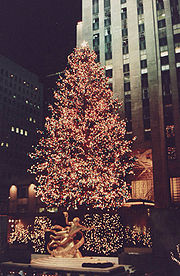
Many cities, towns, and department stores put up public Christmas trees outdoors, such as the Rich's Great Tree in Atlanta, the Rockefeller Center Christmas Tree in New York City and the large Christmas tree at Victoria Square in Adelaide. During most of the 1970s and 1980s, the largest Christmas tree in the world was put up every year on the property of The National Enquirer in Lantana, Florida. This tradition grew into one of the most spectacular and celebrated events in the history of southern Florida, but was discontinued on the death of the paper's founder in the late 1980s.


 Rockefeller Center tree


In some cities, a Festival of Trees is organised around the decoration and display of multiple trees as charity events. In some cases the trees represent special commemorative gifts, such as in Trafalgar Square in London, where the City of Oslo, Norway presents a tree to the people of London as a token of appreciation for the British support of Norwegian resistance during the Second World War; in Boston, where the tree is a gift from the province of Nova Scotia, in thanks for rapid deployment of supplies and rescuers to the 1917 ammunition ship explosion that levelled the city of Halifax; and in Newcastle upon Tyne, where the 15 m-tall main civic Christmas tree is an annual gift from the city of Bergen, Norway, in thanks for the part played by soldiers from Newcastle in liberating Bergen from Nazi occupation. Norway also annually gifts a Christmas tree to Washington D.C. as a symbol of friendship between Norway and the US and as an expression of gratitude from Norway for the help received from the US during World War II.


Taiwanese aboriginals, tutored by Christian missionaries, celebrate with trees
(Cunninghamia lanceolata) outside their homes.


The United States' National Christmas Tree is lit each year on the South Lawn of the White House. Today, the lighting of the National Christmas Tree is part of what has become a major holiday event at the White House. President Jimmy Carter lit only the crowning star atop the Tree in 1979 in honour of the Americans being held hostage in Iran. The same was true in 1980, except the tree was fully lit for 417 seconds, one second for each day the hostages had been in captivity.

The term Charlie Brown Christmas tree is used in the United States and Canada to describe any poor-looking or malformed little tree. Some tree buyers intentionally adopt such trees, feeling sympathetic to their plights. The term comes from the appearance of Charlie Brown's Christmas tree in the TV special A Charlie Brown Christmas.

In New Zealand, Pōhutukawa trees are described as "native Christmas trees", as they bloom at Christmas time, and look like Christmas trees with their red flowers and green foliage.


New Year tree decoration depicting cosmonaut (USSR, 1960s)


In Russia, the Christmas tree was banned shortly after the October Revolution but then reinstated as a New-year fir-tree (Новогодняя ёлка) in 1935. It became a fully secular icon of the New year holiday, e.g. the crowning star was regarded not as a symbol of Bethlehem Star, but as the Red Star. Decorations, such as figurines of airplanes, bicycles, space rockets, cosmonauts, and characters of Russian fairy tales, were produced. This tradition persists after the fall of the USSR, with the New Year holiday outweighting the Christmas (7 January) for a wide majority of Russians.

Dates
Both setting up and taking down a Christmas tree are associated with specific dates. Traditionally, Christmas trees were not brought in and decorated until Christmas Eve (24 December) or, in the traditions celebrating Christmas Eve rather than first of day of Christmas, the 23 December, and then removed the day after twelfth night (6 January); to have a tree up before or after these dates was even considered bad luck.


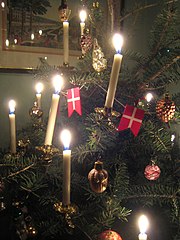
Christmas trees lit by candles, Denmark.


 A giant Christmas Tree in SM Mall Of Asia,Pasay City,Philippines.


Modern commercialization of Christmas has resulted in trees being put up much earlier; in shops often as early as late October — in the UK, Selfridges's Christmas department is up by early September, complete with Christmas trees, and in New York City, street Christmas tree vendors set up their stands shortly after Thanksgiving. Some households in the U.S. do not put up the tree until the second week of December, and leave it up until the 6th of January (Epiphany). In Germany, traditionally the tree is put up on the 24th of December and taken down on the 7th of January, though many start one or two weeks earlier, and in Roman Catholic homes the tree may be kept until late January. In Australia, the Christmas tree is usually put up on the 1st of December, which occurs about a week before the school summer holidays; except for South Australia, where most people put up their tree after the Adelaide Credit Union Christmas Pageants in early December.[citation needed] Some traditions suggest that Christmas trees may be kept up until no later than the 2nd of February, the feast of the Presentation of Jesus in the Temple (Candlemas), when the Christmas season effectively closes. Superstitions say it's a bad sign if Christmas greenery is not removed by Candle mas Eve.


Natural trees
The most commonly used species are fir (Abies), which have the benefit of not shedding their needles when they dry out, as well as retaining good foliage colour and scent; but species in other genera are also used.

In northern Europe most commonly used are:

    * Silver Fir Abies alba (the original species)
    * Nordmann Fir Abies nordmanniana (as in the photo)
    * Noble Fir Abies procera
    * Norway Spruce Picea abies (generally the cheapest)
    * Serbian Spruce Picea omorika
    * Scots Pine Pinus sylvestris
    * Stone Pine Pinus pinea (as small table-top trees)
    * Swiss Pine Pinus cembra

In North America, Central America and South America most commonly used are:

    * Douglas-fir Pseudotsuga menziesii
    * Balsam Fir Abies balsamea
    * Fraser Fir Abies fraseri
    * Grand Fir Abies grandis
    * Guatemalan Fir Abies guatemalensis
    * Noble Fir Abies procera
    * Red Fir Abies magnifica
    * White Fir Abies concolor
    * Pinyon Pine Pinus edulis
    * Jeffrey Pine Pinus jeffreyi
    * Scots Pine Pinus sylvestris
    * Stone Pine Pinus pinea (as small table-top trees)
    * Norfolk Island Pine Araucaria heterophylla


Several other species are used to a lesser extent. Less-traditional conifers are sometimes used, such as Giant Sequoia, Leyland Cypress, Monterey Cypress and Eastern Juniper. Various types of spruce tree are also used for Christmas trees (including the Blue Spruce and, less commonly, the White Spruce); but spruces (unlike firs) begin to lose their needles rapidly upon being cut, and spruce needles are often sharp, making decorating uncomfortable. Virginia Pine is still available on some tree farms in the southeastern United States, however its winter colour is faded. The long-needled Eastern White Pine is also used there, though it is an unpopular Christmas tree in most parts of the country, owing also to its faded winter coloration and limp branches, making decorating difficult with all but the lightest ornaments. Norfolk Island Pine is sometimes used, particularly in Oceania, and in Australia some species of the genera Casuarina and Allocasuarina are also occasionally used as Christmas trees but by far the most common tree is the Monterey Pine. Adenanthos sericeus or Albany Woolly Bush is commonly sold in southern Australia as a potted living Christmas tree. Hemlock species are generally considered unsuitable as Christmas trees due to their poor needle retention and inability to support the weight of lights and ornaments.

Some trees, frequently referred to as Living Christmas trees, are sold live with roots and soil, often from a nursery, to be stored at nurseries in planters or planted later outdoors and enjoyed (and often decorated) for years or decades. Others are produced in a container and sometimes as topiary for a porch or patio. However, when done improperly, the combination of root loss caused by digging, and the indoor environment of high temperature and low humidity is very detrimental to the tree's health; additionally, the warmth of an indoor climate will bring the tree out of its natural winter dormancy, leaving it little protection when put back outside into a cold outdoor climate. Thus, the survival rate of these trees is low. However, replanting when done properly provides higher survival rates.

European tradition prefers the open aspect of naturally-grown, unsheared trees, while in North America (outside western areas where trees are often wild-harvested on public lands there is a preference for close-sheared trees with denser foliage, but less space to hang decorations.

In the past, Christmas trees were often harvested from wild forests, but now almost all are commercially grown on tree farms. Almost all Christmas trees in the United States are grown on Christmas tree farms where they are cut after about ten years of growth and new trees planted. According to the United States Department of Agriculture (USDA) agriculture census for 2002 (the census is done every five years) there were 21,904 farms were producing conifers for the cut Christmas tree market in America, 180,897 hectares (447,006 acres) were planted in Christmas trees, and 13,849 farms harvested cut trees. The top 5 percent of the farms (40 hectares / 100 acres or more) sold 61 percent of the trees. The top 26 percent of the farms (8 hectares / 20 acres or more) sold 84 percent of the trees. Farms less than 0.8 hectare (two acres) comprised 21 percent of the farms, and sold an average of 115 trees per farm.


A tree with fibre optic lights


The life cycle of a Christmas tree from the seed to a 2-metre (7 ft) tree takes, depending on species and treatment in cultivation, between 8 and 12 years. First, the seed is extracted from cones harvested from older trees. These seeds are then usually grown in nurseries and then sold to Christmas tree farms at an age of 3–4 years. The remaining development of the tree greatly depends on the climate, soil quality, as well as the cultivation and tendance by the Christmas tree farmer.

Artificial trees
The first artificial Christmas trees were developed in Germany during the 19th century though earlier examples exist. These "trees" were made using goose feathers that were dyed green. The German feather trees were one response by Germans to continued deforestation in Germany. Feather Christmas trees ranged widely in size, from a small 2-inch (51 mm) tree to a large 98-inch (2,500 mm) tree sold in department stores during the 1920s. Often, the tree branches were tipped with artificial red berries which acted as candle holders.


A vintage aluminium tree, lit by a rotating colour wheel.


Over the years, other styles of artificial Christmas trees have evolved and become popular. In 1930, the U.S.-based Addis Brush Company created the first artificial Christmas tree made from brush bristles. Another type of tree, the aluminum Christmas tree, is made from aluminum. The trees were manufactured in the United States, first in Chicago in 1958, and later in Manitowoc, Wisconsin, where the majority of the trees were produced. Most modern artificial Christmas trees are made from 100% recycled plastics of used packaging materials, such as polyvinyl chloride (PVC) or other plastics. Approximately 10% of artificial Christmas trees are using virgin suspension PVC resin and despite being plastic most artificial trees are not recyclable or biodegradable.

Other gimmicks have developed as well. Fiber optic Christmas trees come in two major varieties, one resembles a traditional Christmas tree. One Dallas-based company offers "holographic mylar" trees in many hues. Tree-shaped objects made from such materials as cardboard, glass, ceramic or other materials can be found in use as tabletop decorations. Upside-down artificial Christmas trees became popular for a short time and were originally introduced as a marketing gimmick; they allowed consumers to get closer to ornaments for sale in retail stores as well as opened up floor space for more products.

Artificial trees became increasingly popular during the late 20th century. Users of artificial Christmas trees assert that they are more convenient, and, because they are reusable, much cheaper than their natural alternative. Between 2001 and 2007 artificial Christmas tree sales jumped from 7.3 million to 17.4 million.


Source
Related Posts with Thumbnails
Bookmark and Share

Sunday, December 27, 2009

The Forbidden Gospel of Thomas

Related Posts with Thumbnails

Bookmark and Share

Hunting Alien Worlds

Q&A: Lowell Observatory astronomer Travis Barman was on the Keck telescope team that made the first direct observations of exoplanets.

In our Top 10 Space Stories of the Decade, the Discovery News #1 story was the direct imaging of planetary systems beyond our own. This endeavor was so profound as it not only opened up a new era for observing extrasolar planets, it ignited the imaginations of the public and scientists alike.

The simultaneous discovery of three alien worlds orbiting the star HR 8799 and a huge exoplanet orbiting the star Fomalhaut were made by the Keck telescope in Hawaii and the Hubble Space Telescope, respectively.

Travis Barman/Lowell Observatory
"He was blinking two images taken at different times. And we were both smiling.
He turned to me and said, 'don't tell anyone.'" -- Travis Barman
Travis Barman/Lowell Observatory


Travis Barman, a member of the Keck team, speaks with Steele Wotkyns, Lowell Observatory's Public Relations Manager, about this historic time in the Fall of 2008.

Steele Wotkyns: Describe your background. You're from rural Georgia. How did you get from there to here?

Travis Barman: My father was the reason we ended up in rural Georgia. He is a biologist and became a professor at Georgia College, a small school in central Georgia. My brother and I grew up in a very academic environment and my parents introduced me to science and computer-related science at a very early age.

I started college at Georgia College but soon transferred to the University of Georgia, double majoring in math and physics-astronomy. About the time I was considering grad school, they hired a new professor, Peter Hauschildt. He brought this huge code called Phoenix, a lot of grant money, and international collaborators. And, right when I was entering graduate school, the field was getting hot. In 1995 51 Pegasi was discovered -- the first "hot Jupiter." I was pretty lucky.

Steele: Describe some of your work. You collaborated on a team that got the very first direct images of planets outside the solar system, what was that like?

Travis: During my first post-doc position (Wichita State), I wrote my first successful grant proposal -- to NASA's Origins program. I decided to take the money to UCLA for my second post-doc where I got involved in the exoplanet direct imaging program. We have been looking for faint, co-moving companions around young stars.

The program is one where you have to have a lot of stamina. There are a lot of null results. You don't find anything... and that goes on for years and years.

But, in 2008 I was at Keck when my colleague Christian Marois was taking images of stars for our program. We always try to pump ourselves up -- this is going to be the one. The odds are really not good, though. So, anyway, on that run I came back late the next morning into the Keck control room. Christian had already done a preliminary reduction of one of the targets, HR 8799. He was blinking two images taken at different times -- the way we find these planets. And we were both smiling. He turned to me and said, "don't tell anyone."

We knew then we had one planet and there was a second one that was sort of visible in the data. It was exciting. But, our team had a lot of work to do. While Christian was cleaning up those images, a third planet was revealed. But we were cautious. And, we were lucky -- we had some more telescope time at Keck and could take more data. So, the story sort of built up: one planet, two planets, three planets -- over a few months. None of us could focus on other work. We just wanted to stare at that image of three planets.

Steele: Was the next biggest discovery for you the first detection of water vapor in the atmosphere of an extrasolar planet?

Travis: That was back in 2007. So I was looking for ideas -- I wanted to put in an archival proposal to look at existing exoplanet data. I was interested in HD 209458. But when I reviewed the literature I discovered what I wanted to do with the data had mostly been done. I was a little bummed but compared those other results to my models anyway. I was amazed at how good the agreement was -- particularly at the longer wavelengths where water absorption was present.

This was a nice, robust little result -- you'd have to work hard to explain the data any other way. Water is definitely there.

Steele: How would you describe the media interest in this discovery?

Travis: It was huge. The media sort of went nuts with it. They let their imaginations run wild, totally wild. I was very careful to say it was water vapor and not liquid water -- many did not make that distinction. It became this media storm. People were very excited by it for many reasons.

Steele: But you are a different kind of astronomer since you focus on the best possible models for how nature behaves and you also do observational astronomy?

Travis: Yes, there's an apparent divide between the two. Both sides approach problems in a different way. I am trying to avoid becoming someone who spends his entire life doing one thing one way. So, for example, taking observations of the three newly discovered extrasolar planets orbiting HR 8799 gives me this opportunity. It's like a working vacation from theory. Being at Lowell gives me a constant connection to observational astronomy.

Observational astronomy is interesting to me. It's similar to when you take something apart and put it back together again -- you learn how all the pieces go together. It gives me a strong appreciation of "real data." But I think one reason you don't see that many people doing both is the danger in being a jack of all trades and a master of none. It takes so much time to be an expert theorist or an expert observer. So, in my career I will always lean towards the one side -- modeling.

Steele: What are you working on now?

Travis: We're following HR 8799 up observationally and I'm taking the lead on one of the exoplanets. This work is exciting since we are getting the first look at planets different from hot Jupiters. These new planets orbit further out from their host star, placing them in a totally different environment than hot Jupiters -- and they are very young planets. They're fresh out of the oven compared to the known hot Jupiters.
Source
Related Posts with Thumbnails
Bookmark and Share
Related Posts Plugin for WordPress, Blogger...

Statistic


View My Stats