Saturday, May 15, 2010

Science & Technology: A Legacy of Lasers


Ever since 1960, when physicists Charles Townes and Arthur L. Schawlow of Bell Labs received the first patent for "Light Amplification by Stimulated Emission of Radiation," Lawrence Livermore National Laboratory (LLNL) has been engaged in the study and use of lasers. And for much of that time, Livermore has been home to the world's largest lasers.

Nova Laser Chamber 
THEN: Inside the Nova laser chamber. Nova, which operated at Livermore from the mid-1980s through the 1990s, produced 30 kilojoules of energy and 25 terawatts of power, making it the world's most powerful laser at the time.
 
Just a few weeks after Theodore Maiman demonstrated the laser for the first time at Hughes Aircraft in Malibu, California, in 1960 (see How Lasers Work), visionary scientists at LLNL recognized the possibility of using lasers to produce fusion energy. The Lab's first laser fusion project, built in 1962, studied the possibility of using powerful, short laser pulses to compress and ignite a small amount of deuterium-tritium fuel in a process dubbed inertial confinement fusion (ICF) (see How to Make a Star).
Even though the lasers of the 60s were minuscule by today's standards, LLNL started evaluating the construction of high-power lasers and laser-driven implosion schemes. The most noteworthy system in those years was named Long Path, LLNL's first neodymium-doped glass disk and multi-pass laser (neodymium is a bright, silvery rare-earth metal used as the active lasing element).
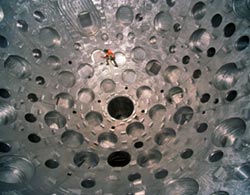
Interior of the NIF Target Chamber 
NOW: Inside the 118,000-kilogram target chamber of the National Ignition Facility. 

Completed in 2009, NIF is designed to generate 1.8 megajoules and 500 terawatts of ultraviolet laser energy, making Livermore once again home to the world's most powerful laser facility.Beginning in 1972, Livermore scientists designed, built and operated a series of increasingly energetic and powerful solid-state systems. It all started with the "4 pi" system and continued with Janus, Cyclops, the two-beam Argus, the 20-beam Shiva, the two beams of Novette, the 10-beam Nova, Petawatt and Beamlet (see "Empowering Light: Historic Accomplishments in Laser Research," Science & Technology Review, September 2002).
And now, the National Ignition Facility continues that tradition. Since the last of its 192 beams were installed in 2009, NIF offers unique capabilities, including the most energy of any laser facility in the world.
With its ability to provide a variety of laser pulse shapes and lengths, including the proposed ultrashort, petawatt (1015 watt) pulses, NIF also will offer more power than any other laser facility. NIF will be about 20 times more powerful than the Nova laser and will deliver about 60 times more energy. When Nova operated with ultraviolet light, it produced 30 kilojoules of energy and 25 terawatts of power. In contrast, the 192-beam NIF will generate 1.8 megajoules and 500 terawatts of ultraviolet laser energy.
LLNL technology has supplied the seed for other large glass laser efforts in the United States, including the Omega laser at the University of Rochester in New York and the Z-Beamlet laser now at Sandia National Laboratory in Albuquerque, NM. Lasers in Japan, France, the United Kingdom, Germany and other countries around the world also use LLNL-developed technology.

Source Related Posts with Thumbnails
Bookmark and Share

The National Ignition Facility: Ushering in a New Age for Science


Hot Hohlraum
“Every great advance in science has issued from a new audacity of imagination.”
—John Dewey
Scientists have been working to achieve self-sustaining nuclear fusion and energy gain in the laboratory for more than half a century. When the National Ignition Facility (NIF) begins ignition experiments at Lawrence Livermore National Laboratory (LLNL) in 2010, that long-sought goal will be much closer to realization.
NIF's 192 giant lasers, housed in a ten-story building the size of three football fields, will deliver at least 60 times more energy than any previous laser system. When all of its beams are fully operational, NIF will focus nearly two million joules of ultraviolet laser energy on a tiny target in the center of its target chamber – creating conditions similar to those that exist only in the cores of stars and giant planets and inside a nuclear weapon. The resulting fusion reaction will release many times more energy than the laser energy required to initiate the reaction.
Experiments conducted on NIF will make significant contributions to national and global security, could lead to practical fusion energy, and will help the nation maintain its leadership in basic science and technology. The project is a national collaboration among government, industry and academia and many industrial partners throughout the nation.
Programs in the NIF & Photon Science Directorate draw extensively on expertise from across LLNL, including the Physical and Life Sciences, Engineering, Computation and Weapons and Complex Integration directorates. This goal is a scientific Grand Challenge that only a national laboratory such as Lawrence Livermore can accomplish.

More Information

Much more information on the NIF & Photon Science Directorate's missions and programs is available on this Website. Here are some links to explore:
  • The Seven Wonders of NIF – How NIF scientists, engineers and technicians overcame a series of daunting technical challenges to bring NIF to the verge of success.
  • How NIF Works – What goes into creating the world's highest-energy laser system.
  • How to Make a Star – Achieving thermonuclear burn in the laboratory.
  • Stockpile Stewardship – Helping protect national security by ensuring that the nation's nuclear weapons are safe, secure and reliable.
  • Inertial Fusion Energy – Exploring new pathways to safe, clean, limitless energy.
  • Photon Science & Applications – Developing advanced high-power, high-intensity laser technology and applications.
  • Laboratory Astrophysics – Providing new tools to study the cosmos.
  • Plasma Physics – Understanding the behavior of turbulent plasmas, the "fourth state of matter."
  • People – Get to know some of the people who make NIF and Photon Science possible.
  • Education – Learn more about lasers and fusion energy.
Source Related Posts with Thumbnails
Bookmark and Share

International team discovers element 117


Element 117
Illustration of the newly created element 117.
Animation by Kwei-Yu Chu/LLNL
Click for animated video

An international team of scientists from Russia and the United States, including two Department of Energy national laboratories and two universities, has discovered the newest superheavy element, element 117.
The team included scientists from the Joint Institute of Nuclear Research (Dubna, Russia), the Research Institute for Advanced Reactors (Dimitrovgrad), Lawrence Livermore National Laboratory, Oak Ridge National Laboratory, Vanderbilt University, and the University of Nevada, Las Vegas.
“The discovery of element 117 is the culmination of a decade-long journey to expand the periodic table and write the next chapter in heavy element research,” said Academician Yuri Oganessian, scientific leader of the Flerov Laboratory of Nuclear Reactions at JINR and spokesperson for the collaboration.
The team established the existence of element 117 from decay patterns observed following the bombardment of a radioactive berkelium target with calcium ions at the JINR U400 cyclotron in Dubna. The experiment depended on the availability of special detection facilities and dedicated accelerator time at Dubna, unique isotope production and separation facilities at Oak Ridge, and distinctive nuclear data analysis capabilities at Livermore.
“This is a significant breakthrough for science,” LLNL director George Miller said. “The discovery of a new element provides new insight into the makeup of the universe and is a testimony to the strength of science and technology at the partner institutions.”
“This collaboration and the discovery of element 117 demonstrates the fundamental importance of scientists from different nations and institutions working together to address complex scientific challenges,” ORNL Director Thom Mason added.
The two-year experimental campaign began at the High Flux Isotope Reactor in Oak Ridge with a 250-day irradiation to produce 22 mg of berkelium. This was followed by 90 days of processing at Oak Ridge to separate and purify the berkelium, target preparation at Dimitrovgrad, 150 days of bombardment at one of the world’s most powerful heavy ion accelerators at Dubna, data analysis at Livermore and Dubna, and assessment and review of the results by the team.  The entire process was driven by the 320-day half-life of the berkelium target material.
Element 117
Illustration of the newly created element 117.
Animation by Kwei-Yu Chu/LLNL
Click for animated video
The experiment produced six atoms of element 117. For each atom, the team observed the alpha decay from element 117 to 115 to 113 and so on until the nucleus fissioned, splitting into two lighter elements. In total, 11 new “neutron-rich” isotopes were produced, bringing researchers closer to the presumed “island of stability” of superheavy elements.
The island of stability is a term in nuclear physics that refers to the possible existence of a region beyond the current periodic table where new superheavy elements with special numbers of neutrons and protons would exhibit increased stability. Such an island would extend the periodic table to even heavier elements and support longer isotopic lifetimes to enable chemistry experiments.
Element 117 was the only missing element in row seven of the periodic table. On course to the island of stability, researchers initially skipped element 117 due to the difficulty in obtaining the berkelium target material. The observed decay patterns in the new isotopes from this experiment, as close as researchers have ever approached the island of stability, continue a general trend of increasing stability for superheavy elements with increasing numbers of neutrons in the nucleus. This provides strong evidence for the existence of the island of stability.
“It fills in the gap and gets us incrementally closer than element 116 — on the edge of the island of stability,” said Ken Moody, one of the LLNL collaborators and a long term veteran of superheavy element research. “The experiments are getting harder, but then I thought we were done 20 years ago.”
This discovery brings the total to six new elements discovered by the Dubna-Livermore team (113, 114, 115, 116, 117, and 118, the heaviest element to date).  This is the second new element discovery for Oak Ridge (61 and 117). In addition, Oak Ridge isotopes have contributed to the discovery of a total of seven new elements.
Since 1940, 26 new elements beyond uranium have been added to the periodic table.
“These new elements expand our understanding of the universe and provide important tests of nuclear theories,” said Vanderbilt University Professor of physics Joe Hamilton. “The existence of the island of stability, a pure theoretical notion in the 1960s, offers the possibility of further expansion of the periodic table with accompanying scientific breakthroughs in the physics and chemistry of the heaviest elements.”
Lawrence Livermore National Laboratory is managed by Lawrence Livermore National Security, LLC for the U.S. Department of Energy's National Nuclear Security Administration. Oak Ridge National Laboratory is managed by UT-Battelle, LLC for the U.S. Department of Energy.
Founded in 1952, Lawrence Livermore National Laboratory is a national security laboratory, with a mission to ensure national security and apply science and technology to the important issues of our time. Lawrence Livermore National Laboratory is managed by Lawrence Livermore National Security, LLC for the U.S. Department of Energy’s National Nuclear Security Administration.

Source Related Posts with Thumbnails
Bookmark and Share

Friday, May 07, 2010

Why are We Here? - Richard Dawkins


Source Related Posts with Thumbnails
Bookmark and Share

The Virus of Faith - Richard Dawkins


Source Related Posts with Thumbnails
Bookmark and Share

The God Delusion - Richard Dawkins

Richard Dawkins

Dawkins at a signing for his book The Greatest Show on Earth: The Evidence for Evolution in 2009.

Clinton Richard Dawkins, FRS, FRSL (born 26 March 1941) is a British ethologist, evolutionary biologist and popular science author. He was formerly Professor for Public Understanding of Science at Oxford and was a fellow of New College, Oxford.[1][2][3][4]
Dawkins came to prominence with his 1976 book The Selfish Gene, which popularised the gene-centred view of evolution and introduced the term meme. In 1982, he made a widely cited contribution to evolutionary biology with the concept, presented in his book The Extended Phenotype, that the phenotypic effects of a gene are not necessarily limited to an organism's body, but can stretch far into the environment, including the bodies of other organisms.
Dawkins is well known for his candid criticism of creationism and intelligent design. In his 1986 book The Blind Watchmaker, he argued against the watchmaker analogy, an argument for the existence of a supernatural creator based upon the complexity of living organisms. Instead, he described evolutionary processes as analogous to a blind watchmaker. He has since written several popular science books, and makes regular television and radio appearances, predominantly discussing these topics.
Dawkins is an atheist,[5][6][7] secular humanist, sceptic, rationalist[8] and supporter of the Brights movement.[9] He has been referred to in the media as "Darwin's Rottweiler",[10][11] by analogy with English biologist T. H. Huxley, who was known as "Darwin's Bulldog" for his advocacy of Charles Darwin's evolutionary ideas. In his 2006 book The God Delusion, Dawkins contends that a supernatural creator almost certainly does not exist and that faith qualifies as a delusion − as a fixed false belief.[12] As of November 2007, the English language version had sold more than 2 million copies [13] and had been translated into 31 other languages,[14] making it his most popular book to date.
Born Clinton Richard Dawkins
26 March 1941 (1941-03-26) (age 69)
Nairobi, Colony of Kenya
Residence Oxford, England
Nationality British
Fields Ethologist, evolutionary biologist
Institutions University of California, Berkeley
University of Oxford
New College, Oxford
Alma mater Balliol College, Oxford
Doctoral advisor Nikolaas Tinbergen
Doctoral students Alan Grafen
Mark Ridley
Known for Gene-centred view of evolution
Introduction of the concept of memes
Advocacy of atheism and rationalism
Criticism of religion
Influences Charles Darwin, Ronald Fisher, George C. Williams, W. D. Hamilton, Daniel Dennett
Notable awards Zoological Society Silver Medal (1989)
Faraday Award (1990)
Kistler Prize (2001)
Notes
Fellow of the Royal Society
Fellow of the Royal Society of Literature


Source Related Posts with Thumbnails
Bookmark and Share

Monday, May 03, 2010

Hawking hurls us superfast into the future


HUMANS may one day be able to use time travel to skip generations into the future, according to Stephen Hawking.
He has suggested humans could build spaceships capable of such high speeds that time itself would slow down for those on board. Such a spaceship could travel thousands of years into the future at close to the speed of light, reaching distant star systems within the lifetime of its crew.
In theory it could allow humans to “colonise the future” — perhaps even returning to repopulate Earth if a disaster caused extinction on this planet during the flight.
“Time travel was once considered scientific heresy and I used to avoid talking about it for fear of being labelled a crank, but these days I’m not so cautious,” Hawking said.
He makes his comments in Stephen Hawking’s Universe, a documentary to be screened by the Discovery channel from next Sunday. A suggestion in another part of the series — that alien life is highly likely to exist but humans should try to avoid it — has already generated global interest.
Hawking’s views on time travel could be just as provocative. He suggests humanity could build a giant “relativistic” spaceship, so called because it would exploit the science set out by Albert Einstein in his theories of relativity.
Einstein found that as objects accelerate through space, the rate at which time passes for them slows down. For objects such as cars and aircraft the effect is negligible, but Hawking’s spaceship would exceed 98% of the speed of light, when such effects would be extremely powerful.
Hawking said such a ship could theoretically reach speeds of more than 650m miles an hour, but would have to be built on a huge scale simply to carry all the fuel that would be needed.
“It would take six years at full power just to reach these speeds. After the first two years it would reach half light speed and be far outside the solar system. After another two years it would be travelling at 90% of the speed of light,” he said.
“After another two years of full thrust the ship would reach full speed, 98% of the speed of light, and each day on the ship would be a year on Earth. At such speeds a trip to the edge of the galaxy would take just 80 years for those on board.”
Hawking dismisses the prospect of time travel into the past. Some scientists have suggested this could be done by exploiting wormholes, gateways linking different parts of the universe or which provide a short-cut backwards or forwards through time.
Theory suggests such wormholes do exist at the quantum scale, meaning they are far smaller even than atoms, so the challenge would be to enlarge them to a human scale.
Hawking dismisses this idea, pointing out that time travel into the past would create the “mad scientist paradox” where a researcher could travel back in time and shoot his past self, raising the question of who could have fired the shot.
“This kind of time machine would violate a fundamental rule that cause comes before effect,” said Hawking. “I believe things cannot make themselves impossible. So it won’t be possible to travel back to the past — using wormholes or any other method.”
Other physicists back Hawking’s theories but also acknowledge the technical challenges. Among them is Brian Cox, professor of particle physics at Manchester University and presenter of the recent BBC television series Wonders of the Solar System.
“We can already see how time slows down for objects travelling at high speed by looking at what happens in particle accelerators,” he said.
“When we accelerate tiny particles to 99.99% of the speed of light in the Large Hadron Collider at Cern in Geneva, the time they experience passes at one seven-thousandth of the rate it does for us.”
“If we could build a spaceship that was fast enough, then it could reach other stars in the lifetime of the crew — but maybe 2.5m years would have passed by on Earth.”
Source Related Posts with Thumbnails
Bookmark and Share
Related Posts Plugin for WordPress, Blogger...

Statistic


View My Stats