Saturday, May 15, 2010

NASA Images is a project of the Internet Archive


NASA Images is a project of the Internet Archive and was created through a Space Act Agreement between the Internet Archive and NASA to bring public access to NASA's image, video, and audio collections in a single, searchable resource. The NASA Images team works closely with all of the NASA centers to keep adding to the continually updated collection at nasaimages.org. The site launched in July 2008 and now has more than 100,000 items online, all of which are available for free download.
Source Related Posts with Thumbnails
Bookmark and Share

Rockwall-based Armadillo Aerospace signs deal with
Space Adventures to sell suborbital rocket flights for $102,000

rocket armadillo b.JPG
credit: Armadillo Aerospace / Rocket Racing Inc

With a target price of $100,000 per ticket or less, launch vehicle developer Armadillo Aerospace and Rocket Racing League company Rocket Racing Inc are aiming to offer suborbital flights from New Mexico's Spaceport America from 2010

The image above is the rocket concept the two companies have released to the media

Rocket Racing Inc chief executive Granger Whitelaw says: "The price of space is coming down to Earth. And thanks to Armadillo's ships and New Mexico's spaceport, human beings will be treated to the most stellar views in the galaxy."
See more images of the joint venture's concept vehicle, some comment by me and Virgin Galactic's reaction in the extended portion of this blog post

click on all the images in this blog post to see larger versions in the same browser window

rocket armadillo c.JPG


rocket armadillo a.JPG
credit: Armadillo Aerospace / Rocket Racing Inc

This design had been on Armadillo's website for some time although just checking the site now it has disappeared

I was expecting something new for the concept. It is interesting that this has come out after the non-arrival of a reportedly "imminent" deal between Spaceport America and Virgin Galactic

While Armadillo has "proven" technology with its Rocket Racer engine I am not entirely convinced that that powerplant, or a cluster of seven of them, could really push even a two-person transparent capsule to above 100km

For a start the design above is not very aerodynamic and will waste a lot of fuel just trying to overcome that hurdle in the first 30,000ft (9,150m) of atmosphere but they also want a vertical powered descent with all the structural inefficiencies and fuel requirements that will bring

I don't understand why they didn't opt for this design (see below) and build in a transparent section, assuming any existing transparent material is going to be able to cope with the aerothermodynamic loading on ascent

missile concept armadillo.jpg
credit: Armadillo Aerospace 

Virgin Galactic president Will Whitehorn's reaction is, "...for Armadillo/Rocket Racing league, good luck to them"

Coming back to the whole Spaceport America involvement, there has been very slow progress towards Virgin signing an anchor tenant contract for some time with a memorandum of agreement inked a while back

The New Mexico government even made getting an anchor tenant part of its legislation for the creation of the spaceport and with the MOA Virgin seemed destined to fill that role, but are they?

Contacting Whitehorn this evening (UK time) he emailed me to say, of the new 'imminent' agreement, "this is the new agreement for the actual lease and facilities to the Fosters/URS design now finalised, which will supersede the original MOA."

One has to wonder though if the New Mexico government is concerned that they will have an utterely empty $225 million spaceport, cum white elephant, on their hands if Virgin Galactic, which rolled out an empty WhiteKnightTwo mothership in July, doesn't start flying in 14-months time. They could still be test flying SpaceShipTwo in 2010 at Mojave air and space port

I also wonder about the likelihood of Armadillo test flying so soon. It seems rather challenging, to say the least, for any company to go from a concept that has a habitable section that has untested technologies, sub-systems, let alone a proof of concept test article, and no successful flights of anything that could be called a prototype propulsion module, to flight tests inside of 12-months, assuming they make their first flght in December 2009

So the Armadillo, Rocket Racing, New Mexico government link up probably is a step to shore up political support for the spaceport, to give that impression of a growing list of tenants that includes Up Aerospace and maybe even the UK's Starchaser Industries

Being here in the UK and not having anyone in New Mexico to attend the press conference on our behalf, I have submitted a bunch of questions by email. Let's see what they say!


Source Related Posts with Thumbnails
Bookmark and Share

Jupiter loses one of its belts


Jupiter and its system of belts and zones. The Red Spot is a hurricane-strength storm that's been present on the planet for at least the past few hundred years. Credit: NASA
Sunday morning when Jupiter and the moon came up together in the east I was tempted to remain outside with the birds and growing light and observe the planet, but it had been a long night and I desperately needed sleep. As the sun continues to move away from Jupiter, the planet will rise higher and in time become more conveniently placed for viewing. Still, intrepid sky watchers with small telescopes may want to consider making an early morning pilgrimage to the king of the planets to see for themselves how Jupiter's gotten something of a makeover.
Last winter changes were already underway as the South Equatorial Belt, one of the two most prominent dark "stripes" on the planet, began to fade. Most years you look at Jupiter and besides the four little moons lined up on one side or another of the planet, you'll see two prominent dark grey bands, the north and south equatorial belts. These and Jupiter's other belts are separated by lighter-colored zones giving it a striped appearance. Both belts and zones are composed of ammonia ice crystals which freeze out at 108 degrees below zero, a temperature easily attainable at Jupiter's half-billion mile distance from the sun. Materials like sulfur and phosphorus mixed in with the ammonia are believed responsible for creating the clouds' curious red, brown and yellow tints.


Watch Jupiter rotate and its cloud belts move with the winds. The time-lapse video was made using images shot during Voyager 1's flyby of the planet in 1979.
The origin of all these belts and zones comes from deep below the planet. Bubbles of warmer air rise to the upper atmosphere and condense into clouds where they're are blown into alternating bands by 350+ mile per hour winds. Jupiter's rapid rotation is at the source of its ferocious winds -- a day on the planet whisks by in just 9.9 hours. This speedy spin coupled with Jupiter's gaseous nature is also the reason the planet is flattened like a squashed meatball instead of being more nearly spherical.

Look at the dramatic change in the planet from less than a year ago. The South Equatorial Belt (SEB) has faded away leaving just the north belt (NEB) viewable in small telescopes. Credit: Anthony Wesley
So here's the surprise. That bad boy south equatorial belt (SEB) has completely faded away. Point your scope at the planet any morning soon and you'll see only one obvious dark stripe, the North Equatorial Belt. Jupiter with only one belt is almost like seeing Saturn when its rings are edge-on and invisible for a time -- it just doesn't look right.
The SEB is one of the most active areas on the planet for weather changes. Every 3-15 years, the belt, which is normally dark reddish-brown in color and typically divided in two by the south equatorial belt zone, fades from view. After some weeks or months a brilliant white spot forms within that zone and begins spouting dark blobs of material which get stretched into filaments and ovals by Jupiter's fierce winds into a new SEB. Within a few weeks (or longer) the belt is back and Jupiter presents its familiar dual "tire track" appearance through a telescope.


When the South Equatorial Belt fades, the Great Red Spot, here seen at the planet's left edge, usually becomes darker and more prominent. Credit: Anthony Wesley

The phenomenon goes by the name of the South Equatorial Belt Disturbance, and the changes are dramatic enough to see their evolution night by night. That's why I'd like to urge you to set the alarm and take a look at Jupiter in the next few weeks. Later this season, when the planet grows a new face, you'll be able to appreciate how quickly a celestial object like a planet can change. It's part of the reason amateur astronomers observe them as often as they can much to their spouses' amusement.
To find Jupiter, go out about an hour before sunrise and look a fist or two above the horizon in the east-southeastern sky. It's the only bright "star" you'll see there.
SourceRelated Posts with Thumbnails
Bookmark and Share

Panoramic Wall Mounted Aquariums from AquaVista


5-12-10aquarium1.jpg

The AquaVista 500 just got super sized and now comes in a panoramic 20 and 25 gallon version. Measuring only 6" deep, it'll accommodate all but the chubbiest fish and comes complete with an automatic feeder, filtration, heater, air pump, light and touchscreen control panel.
Fairly plug and play, the Aquavista Panoramic comes with 2 steel reinforced mounting brackets which allow you to hang the aquarium like a flat screen TV, add water, and your water loving friends. It comes in black or silver and is available in two dimensions: 5 ft or 6 ft wide.
5-12-10aquarium2.jpg
Product Highlights:

  • Low Maintenance, requires less than 15 minutes per month
  • No Daily Care – complete with embedded Automatic Feeder
  • Pre-assembled
  • Dual filtration system
  • Heater
  • Air pump
  • Lighting
  • Easy to use control that simplifies all functions.
  • Carbon Dioxide Generator
  • Programmable touch-screen
Source Related Posts with Thumbnails
Bookmark and Share

Bathe Under The LED Shower


Bathe Under The LED Shower 

Tranquil music is filtering in through the open door. You open your mouth and tilt your head back, imagining you're drinking the blue drops from a waterfall. Sounds like heaven, right?
It's actually a snazzy shower fitting from Domolight, able to change LED colors as a form of "colortherapy." It comes with a remote control to change colors and water flow, with the minimum being 25L every minute. You know what they say, if Apple stores had showers... [Edil Portale via Archi Portale via Born Rich]

Bathe Under The LED Shower


Source Related Posts with Thumbnails
Bookmark and Share

Travel Between LA and Vegas Without
Fear Or Loathing On The Gambling Train


 Now that road-safety laws have tightened up since the '70s when Fear and Loathing was published, you'll need to look at alternative transport for your LA-to-Las-Vegas trip if you want to play Hunter S. Thompson while under the influence.

A gambling train? Sure, I think Thompson would improve. There are no bats on trains, after all.
Believe it or not, the X Train is actually going to happen, with the developers boasting of a 2011 launch. It'll use converted railcars, and as the renders show it'll be very red! plush! swirly-swirly! plush! Though apparently one of the photos—this one—is actually a real-life photo from the Blue Train, in South Africa. Puzzling.

Despite doubts over one of the photos, you've got to admit it's a bloody cool idea. It'll take 5.5 hours to travel between the two cities—with no Tobey Maguire-lookalike hitch-hikers to be found, hopefully. [X Train via Core77 via FastCompany]

Source Related Posts with Thumbnails
Bookmark and Share

Science & Technology: A Legacy of Lasers


Ever since 1960, when physicists Charles Townes and Arthur L. Schawlow of Bell Labs received the first patent for "Light Amplification by Stimulated Emission of Radiation," Lawrence Livermore National Laboratory (LLNL) has been engaged in the study and use of lasers. And for much of that time, Livermore has been home to the world's largest lasers.

Nova Laser Chamber 
THEN: Inside the Nova laser chamber. Nova, which operated at Livermore from the mid-1980s through the 1990s, produced 30 kilojoules of energy and 25 terawatts of power, making it the world's most powerful laser at the time.
 
Just a few weeks after Theodore Maiman demonstrated the laser for the first time at Hughes Aircraft in Malibu, California, in 1960 (see How Lasers Work), visionary scientists at LLNL recognized the possibility of using lasers to produce fusion energy. The Lab's first laser fusion project, built in 1962, studied the possibility of using powerful, short laser pulses to compress and ignite a small amount of deuterium-tritium fuel in a process dubbed inertial confinement fusion (ICF) (see How to Make a Star).
Even though the lasers of the 60s were minuscule by today's standards, LLNL started evaluating the construction of high-power lasers and laser-driven implosion schemes. The most noteworthy system in those years was named Long Path, LLNL's first neodymium-doped glass disk and multi-pass laser (neodymium is a bright, silvery rare-earth metal used as the active lasing element).

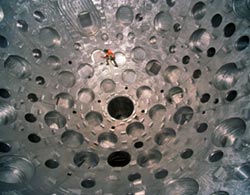
Interior of the NIF Target Chamber 
NOW: Inside the 118,000-kilogram target chamber of the National Ignition Facility. 

Completed in 2009, NIF is designed to generate 1.8 megajoules and 500 terawatts of ultraviolet laser energy, making Livermore once again home to the world's most powerful laser facility.Beginning in 1972, Livermore scientists designed, built and operated a series of increasingly energetic and powerful solid-state systems. It all started with the "4 pi" system and continued with Janus, Cyclops, the two-beam Argus, the 20-beam Shiva, the two beams of Novette, the 10-beam Nova, Petawatt and Beamlet (see "Empowering Light: Historic Accomplishments in Laser Research," Science & Technology Review, September 2002).
And now, the National Ignition Facility continues that tradition. Since the last of its 192 beams were installed in 2009, NIF offers unique capabilities, including the most energy of any laser facility in the world.
With its ability to provide a variety of laser pulse shapes and lengths, including the proposed ultrashort, petawatt (1015 watt) pulses, NIF also will offer more power than any other laser facility. NIF will be about 20 times more powerful than the Nova laser and will deliver about 60 times more energy. When Nova operated with ultraviolet light, it produced 30 kilojoules of energy and 25 terawatts of power. In contrast, the 192-beam NIF will generate 1.8 megajoules and 500 terawatts of ultraviolet laser energy.
LLNL technology has supplied the seed for other large glass laser efforts in the United States, including the Omega laser at the University of Rochester in New York and the Z-Beamlet laser now at Sandia National Laboratory in Albuquerque, NM. Lasers in Japan, France, the United Kingdom, Germany and other countries around the world also use LLNL-developed technology.

Source Related Posts with Thumbnails
Bookmark and Share
Related Posts Plugin for WordPress, Blogger...

Statistic


View My Stats